
RTI Act Rendered Redundant by New Maharashtra Rules
Citizens say that the latest Maharashtra RTI Rules, 2026, is a pushback, making access to information more cumbersome, exorbitantly expensive and an indirect way to deny information. Ashutosh M Shukla* reports.
The Maharashtra RTI Rules, 2026, which came into effect in the second week of June is among the most recent moves that citizens feel make the transparency Act redundant and access to information more difficult. The new rules in Maharashtra come shortly after the central government notified rules for the Digital Personal Data Protection (DPDP) Act, 2023 that amended and did away with sections of the Right to Information Act (RTI), which had brought the lay person on par with elected representatives when it comes to access to information. The introduction of new rules, say citizens, is no different.
“There was no consultation at all before these rules were brought in. They should have consulted citizens before making these rules,” said Shailesh Gandhi, former central information commissioner. By not doing so, citizens and activists said the government embarrassed itself by withdrawing a significant part of the rule that contravene the Act within days of issuing the notification. They pointed to the withdrawal of the application format of RTI application that made it mandatory for an applicant to provide reasons as to why they require information. It contravened Section 6 (2) of the RTI Act which states that an applicant need not provide reasons for seeking information.
“A citizen seeks information as a pro-active citizen looking for transparency and promoting it. It is obvious. What is there to state in this? The Act very clearly states that no further information should be asked from the applicant to provide information. In fact, there are court orders which state that even a post box number should suffice and no other information be sought from the applicant,” said Bhaskar Prabhu, convenor of Mahiti Adhikar Manch, an organisation that propagates RTI and its usage in Maharashtra.
The condition of providing reasons aside, activists and citizens have criticised the rules for making access to information more difficult, cumbersome, expensive, creating more open-ended ways to deny information. In addition, there are discrepancies in the Marathi and English versions. There is also a belief that the underlying intention or the hidden interest behind the new set of rules was to discourage applicants and prohibit them from using the transparency act and make it more restrictive.
“They have tried to make the rules comprehensive by combining earlier rules. The rules are excellent in integrating many things, but they have also added things that are contravening the parent act. There was no pre-consultation with citizens. It is a settled principle that two months’ time is to be given for suggestions and objections from citizens before rules are prepared,” said Pralhad Kachare, retired additional collector and former director of RTI Centre at Yashada, a resource center for RTI.
Citizens believe much of the anxiety could have been settled and rules further streamlined had there been some interaction while making the rules for a law that is known to have come out of peoples’ movement. “They have not only made it cumbersome for applicants but also officials. It is clear that some aspects of the rules are made by senior officials who have never been public information officers or have interacted with them,” said Venkatesh Nayak, director, Commonwealth Human Rights Initiative, New Delhi involved in the implementation of RTI Act in India.
“They have asked for documents related to citizenship while not even listing which documents qualify. Once provided, how will a PIO validate if the document provided is right or wrong. Courts have already stated that citizenship should be asked only if the public information officer has apprehensions about the same,” said Nayak. This when much of the pushback against RTI came from officials as they said it hampered their other routine work. The new rules, argue citizens, will unnecessarily burden applicants across Maharashtra. “It is not like Mumbai or Goa where you may find people of other nationalities. Why should a rule be put in place that will have ramifications for people across Maharashtra?” asked Kachare. Citizens are also apprehensive of a larger population not being able to provide certain documents that may prove citizenship or the fact that a person may no longer be a citizen after birth.
Another point of contention introduced is the “personal information” and hike in charges including in case of applicants from the ‘Below Poverty Line (BPL)’ category. “They say any information which directly or in combination with other information that can ‘identify a person’ is personal and exempt. This leaves things to imagination. Anything can lead to identifying a person, termed as personal information and denied. We are heading into a very scary situation,” said Gandhi.
Citizens said that what is not in the Act, should not have been created in the rules as it creates problems. “Requiring applicants to prove larger public interest when personal information could be involved raises the evidentiary burden improperly on the applicant,” said Prabhu. “Unfortunately, when it comes to privacy and personal information, recent judicial pronouncements have expanded the scope of privacy but simultaneously not elaborated on the scope of RTI even though the fact that RTI is a fundamental right has come from previous judicial pronouncements,” said Gandhi.
In the case of BPL applicants, the RTI Act allowed free information. This provision was misused by some. “In the case of Below Poverty Line, there were practical issues and PIOs were harassed. But the rules should not have created issues that are contentious and not consistent with the parent law. They should have done this lawfully. They should have let Parliament make amendments to the number of pages that will be free and those that will be charged when a person from BPL is making the application. The RTI Act is very clear when it states what can be prescribed in rules like charging of fees,” said Kachare.
Charging applicants “exorbitantly” has been criticised uniformly by most. The jump is staggering both in application, first appeal and second appeal. Earlier, an applicant had to pay only Rs 10 to make an RTI application. This would jump to Rs 20 for first appeal and Rs 20 for second appeal. Now the cost of an application is Rs 30, while that of first appeal is Rs 50 and second appeal Rs 100. After making an application, once the applicant is to make payment, he has to shell out more than double of what he did earlier for information. Each A4 size paper that would cost Rs 2, will now cost Rs 5. Charges for inspection have also been increased. After the first hour that is free it has jumped from Rs 5 to Rs 50 for every subsequent hour of inspection.
“It is nearly 21 years since the RTI Act came into force but they could have doubled the fees. Right now the money being charged is exorbitant. If you go to a market place, they charge Rs 2 for a page after adjusting profit. Is the government so cash starved that it is looking to make money out of this,” questioned Nayak. Information that is free like those declared suo motu, the government has said it will not attest and give out. “This is concerning. Tomorrow, if the information on the website is not there or the link removed, how do they expect citizens to prove their case? A lay person is not an expert. They have even said that legal practitioners cannot represent the applicants,” said Gandhi. Rules are also not uniform when it comes to Marathi and English versions. In the Marathi version, rules categorically state that if an applicant cannot attend a hearing, they cannot authorise a legal practitioner while the English version states that they ‘may’.
Authenticity of the information aside, activists in particular are concerned about no information coming through if the applicant cannot attend the hearing. Rules, they say, are not factoring coercion an applicant may face to not attend RTI hearing. “The rules state that information may not be given if an applicant skips hearings persistently. Why should that be the case? Based on record and written submission, the Commissioner should pass the order to provide information,” said Gandhi.
Activists see the point in providing information as they have been seeking in case of attacks or murder of RTI applicants. “Satish Shetty was killed in 2010. It has been 16 years and the case is still going on. Information he sought was asked to be put in public domain,” said Nayak. He added that Commissioners should ensure that information is made available in the public domain. As for suo motu disclosure, activists and citizens have welcomed the decision of making the head of the public authority accountable. “But if the Municipal Commission or the Commissioner of Police is going to further delegate this work, that should be put out clearly in public domain along with who is going to take action for dereliction. It is the only saving grace in the rules in what comes across as draconian with a dictatorial way in which it is dictated down to citizens without any consultation,” said Prabhu.
Key Changes in New Maharashtra RTI Rule
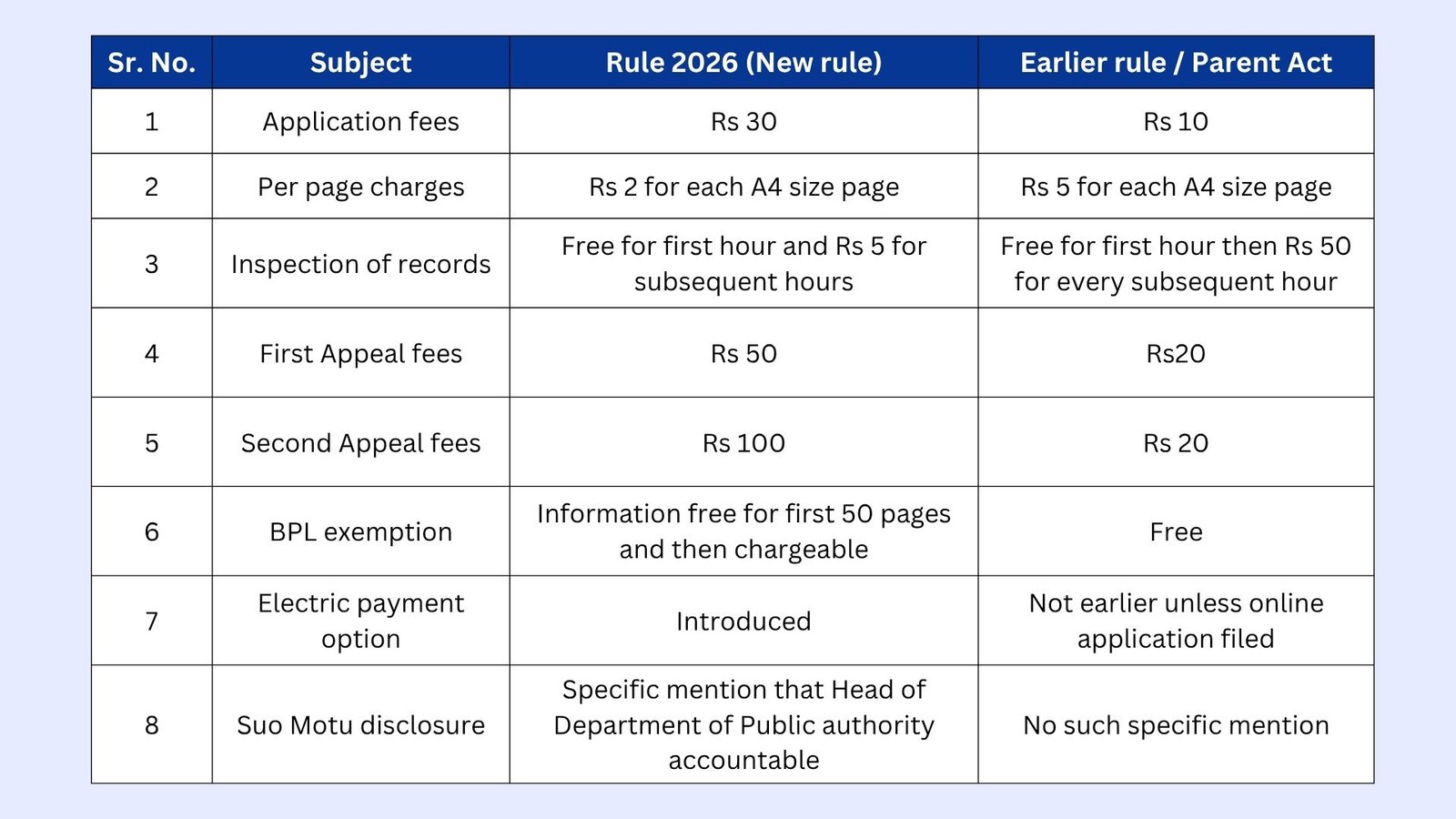
Introduced but contrary to parent law or not defined in it:
Purpose of information (Now stands withdrawn)
This was to be stated as per new Rules (application format) but now stands withdrawn. As per the Act, no information other than that required to contact be provided.
Photo ID (Citizenship): mandatory through proforma of application seeking citizenship proof. No list of documents mentioned that can prove citizenship.
Personal information exempted: puts burden of larger public interest on applicant. Rule defines and exempts personal information by stating “means any information which relates to an identifiable individual, whether directly or indirectly, and which, either by itself or in combination with other information available or likely to be available, is capable of identifying such individual”
The RTI Act was amended through the DPDP which stated that information that cannot be denied to Parliament or Legislature cannot be denied to citizens.
What has been retained?
One subject: new rules retain that only one subject will be dealt with in each application
Word limit: 150 word limit for RTI application
*Ashutosh M Shukla is a Mumbai-based journalist and has reported extensively on RTI and its impact for more than a decade.
Policies/Regulations
Related


Commentaries