
The Limits of Free Speech: Caste, Power, and Campus Democracy
The stories of campuses are not only those of repression but also of resistance, says Ruchi K*, examining the current attempts to censor and regulate free expression in university campuses in Delhi.
The shocking testimonies of eleven students who were abducted and tortured by the special cell of Delhi police, some of them subjected to sexual violence, illustrates how campus dissent is being policed and criminalised. Coming in the wake of the UGC regulations and protests that followed, it is the most extreme attempt to silence students and shame them into submission.
The incident of alleged abduction and custodial torture of the students on March 12, 2026 marks a disturbing escalation in the relationship between the state and dissenting voice. Eleven students and young activists—Shiv, Manjeet, Rudra, Ilakkiya, Baadal, Avinash, and others—were picked up by unidentified personnel in plain clothes and were subjected to horrendous torture. Last year, a few of them, including Ilakkiya, Kiran and Akshay had spent a month in Tihar jail following the India Gate protest against severe pollution in Delhi.
What is striking is how students’ activism, traditionally a legitimate form of democratic engagement, is now framed as a threat. The larger justification by law enforcing authorities and university authorities for extra-legal policing is indicative of the blurring of boundaries of academic dissent.
Universities are no longer insulated spaces of debate but integrated into wider apparatus of surveillance and control.
The Ruchi Tiwari Case: When Media Becomes Provocation
While universities and campuses have always been the spheres of ideological conflict and interaction, publicly raised slogans of “Brahmanvad zindabad” also reveal the political character of the state.
On February 13, 2026, a protest at Delhi University (DU)’s Arts Faculty has organised by the All India Students’ Association demanding implementation of the UGC Equity Rules against caste discrimination. The manner in which competing narratives emerged in the fracas over You Tuber Ruchi Tiwari exposed both the fragility of campus democracy and the partisan nature of both university authorities and law enforcing agencies.
Tiwari alleged she was attacked by hundreds of protesters who “whispered rape threats in my ears just because I am a Brahmin.” AISA countered that Tiwari had hurled casteist slurs first and snatched a phone and physically attacked a Bahujan journalist. Police registered two cross FIRs.
Videos later showed YouTuber Megha Lawariya raising “Brahmanvad Zindabad” slogans outside the police station, a phrase that would echo across Jawaharlal Nehru University (JNU) days later. Interestingly, the woman who raised “brahmanwad zindabad” slogan comes from a marginalised community.
The UGC Regulations
The genesis of this conflict was in the newly notified UGC (Promotion of Equity in Higher Educational Institutions) Regulations, 2026. While its aim was to prevent caste discrimination in higher education, it contains serious weaknesses that may undermine that goal. The regulations were originally framed after tragic incidents of caste discrimination in higher education institutions, including the suicide of Rohith Vemula, Payal Tadvi and earlier cases involving SC/ST (Scheduled Castes/Scheduled Tribes) students. In response to such incidents and pressure from the Supreme Court and affected families, the UGC introduced the 2012 regulations to curb discrimination. The 2026 regulations are a revised version of the 2012 framework.
However, the “Ruchi Tiwari” incident and the spectacle by the media now shapes campus conflict. While some students from Delhi’s north campus experienced the tension between friendship and political views on the UGC Regulations, the space for genuine dialogue has collapsed. When every protest becomes media ‘content’ and every confrontation goes viral, the state’s political character is revealed by which narrative it privileges through police action and FIRs.
The incident also reminds us of Ulrich Baer’s contention in his book What Snowflakes Get Right (2019) that equality is hollow without free speech. Students recognise that meaningful speech requires conditions where every community speaks as equals. Baer reminds us that the right to speech means little when you cannot be heard. In the Tiwari case, whose speech counted? Whose victimhood was believed? The answer reveals power, not truth.
DU’s One-Month Ban
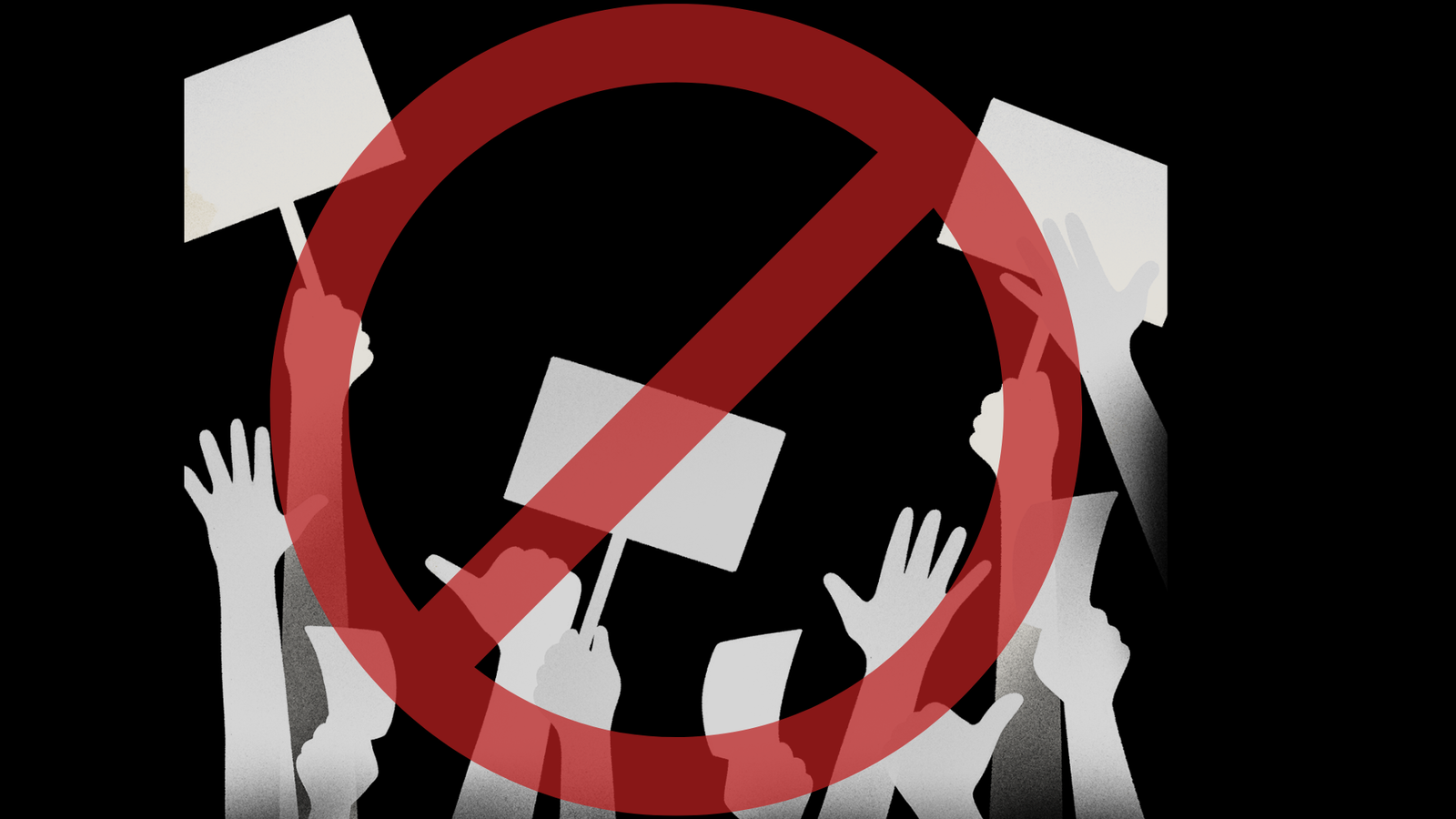
On February 17, 2026, the DU Proctor issued an order prohibiting “public meetings, rallies, dharna, protests, assemblies of five or more people” for one month. The ban extended to “shouting slogans and making speeches.” Affiliated colleges “advised” students against posting “controversial content” on social media. This notice shows a troubling expansion of administrative control over democratic space within the university by prohibiting even peaceful assembly.
What does it mean when a gathering of five students becomes a violation and a law-and-order problem? In this politics of isolation, an administration that is not neutral disperses collective bodies so that dissent cannot take shape. It was with this understanding that the Democratic Teachers’ Front called this “a draconian measure designed not to maintain peace, but to stifle legitimate democratic expression.”
With hundreds of CCTV cameras in classrooms and across university campuses, students internalise surveillance and learn to self-censor. The panopticon comes to campus.
Slogans and the State’s Political Character
On January 29 this year, the Supreme Court stayed the UGC Equity Rules and observed that India was becoming a “regressive society” after “75 years of trying to make a caste-less society,” thereby revealing how institutions struggle to address structural inequality.
But state apparatus such as police and public officials fail to interrupt or worse, tacitly endorse slogans like “Brahmanvad Zindabad” and “Desh ke gaddaro ko goli maro salo ko” chanted in support of Ruchi Tiwari while threatening DU students outside the Maurice Nagar Police Station. Such chants shield the hegemonic ideology of dominant actors under the garb of free-speech rhetoric, but other students are targeted and criminalised.
Ambedkar has pointed out that caste is not just about differences, it is a graded inequality and emphasized that social democracy must come before political democracy. When ‘’Brahmanwaad zindabaad” is shouted, it is not an isolated phrase, but an echo of Manu, of untouchability and social death. It shows not ‘’free speech” but power. A power that reminds a powerless community of its “place” in society.
UGC Equity and Mandal’s Ghost: Student Views
The UGC Regulations, 2026 emerged from lived experiences across students and petitions filed by mothers of Rohith Vemula and Payal Tadvi, following their ‘’institutional murders. Students and student organisational bodies were split sharply over the issue.
While the ABVP welcomed the Supreme Court stay, the JNUSU called it “deeply shameful and unfortunate,” and demanded a comprehensive “Rohith Vemula Act.”
Priyanka Ghosh of the Students Federation of India (SFI) said, “Funny how the same concern never kicks in when upper-caste privilege quietly divides campuses every single day.”
For Aniket Gautam, a political science student, the UGC equity regulations never meant to provide substantive justice to Dalit students in the “open prisons of Indian academia.” Recalling the words of Rohith Vemula, “Please do serve the 10 mg of cyanide to every Dalit student at the time of their admission”, Gautam felt that “Every tiny space of the higher education institutions appeared like an enclosed cell. I call it “enclosed” for the fact that Savarna superiors are my wardens and jailors. I cannot move beyond their “state of exception.”
Further, he added how, ultimately, the Mandal ghost never left its presence; instead, it expanded itself similar to veins floating in the academia body.
We can see the agitation parallel to Mandal commission back in the 1990s: the same anxiety of the upper castes, the same language like “reverse discrimination,” when upper castes fear losing their privileges enjoyed since birth.
Criminalising Dissent
On 26 February 2026, 14 JNU students including the JNUSU president and vice president were arrested during a march to the Ministry of Education. They were sent to Tihar Jail and granted bail on Rs 25,000 bonds each, while their release was delayed by “stringent documentation conditions”.
This is a reflection of a broader trend where student politics is framed as a “disruption,” and not democratic participation. The politics of discipline is casteist and discriminatory and there are multiple examples, from the repeated suspension of a Dalit PhD scholar at TISS; the expulsion of AUD students for participating in protests; the repeated violence on Jamia students and the detention of JNU students including JNUSU president and vice president.
Casual remarks by Vice Chancellors of public universities reflect a language of discrimination. The DU Vice Chancellor said in his speech ”Naxalism… has moved from forest to universities” while the JNU VC’s derogatory remark that “Dalits and Blacks” cannot progress by being permanently a victim or playing the victim card (“drugged with permanent victimhood”).
Such narratives delegitimise structural critiques of caste and inequality and portray campus dissent as either ideological subversion or exaggerated grievances. They shift attention away from material reality of caste hierarchy and caste exclusion that shape access to higher education in India.
They also shift the terrain of contestation inside universities. To read these statements from higher authorities of public universities shows how language, policing and policy conspire to structure universities into spaces of ideological reproduction, resonating with French philosopher Louis Althusser’s description of universities as ”ideological state apparatuses’’. As per the Althusserian dictum, that there is no “outside” of ideology. Consequently, the academic space, is necessarily a terrain upon which this struggle is waged and concealed.
In analysing how the gap between teachers and students occurred, Prof. N. Sukumar, a Dalit scholar and professor at Delhi University, expressed in an interview in Khabar Khalihaan how it took 20 years in DU’s political science department to make an SC professor permanent within that elite academic space.
Therefore, the gap between professor and students should be noted because it is not merely a pedagogical but sociological gap, but because faculty members often come from backgrounds endowed with long-standing cultural and social capital that shapes their authority, confidence, and access to networks across generations. This distinction is apparent within classrooms too.
Critically, these developments must be read not as isolated excesses but as part of a continuum linking campus restrictions, protest bans, and the criminalisation of dissent.
A Fatal Silence
Indian campuses and universities are not competing claims of victimhood or isolated influences but structural conditions that shape who is allowed to speak, heard and disciplined. When provocative slogans are chanted, peaceful assemblies prohibited, student activism is met with arrests or labelled as anti-national, it illuminates deeper ideological work by universities.
The story of Rohith continued to haunt. In his final letter, he described his death as “Fatal Accident.” A personal tragedy is institutional failure. Everyday caste humiliation and political targeting of activists create conditions where Rohith Vemula’s words expose how universities can transform space meant for intellectual freedom into sites of silent violence.
Yet, the stories of campuses are not only of repression but also of resistance. Universities are spaces of democratic engagement by students, teachers, and independent scholars who seek to build spaces where marginalized voices can be heard.
(*Ruchi K is pursuing a master’s degree in Political Science at the University of Delhi and is a student activist with an abiding interest in state politics, gender and intersectionality, caste and class relations, and questions of democratic struggles in contemporary India.)
Censorship
Related

Commentaries