
Does “a public” have a right to a “private” screening?
There needs to be a serious rethink about the CBFC prohibition on film screenings organised for an informed audience, in a ‘not-for’profit’ space which the general public would not have unrestricted access to.
By Geeta Seshu
The recent announcement by the Central Board of Film Certification (CBFC) about public screenings of films without certification or exemption raises important questions about the definition of a “public” screening and the freedom of audiences to view films collectively.
On Sept 17, in a veiled warning, posted on X, the CBFC said “Public screening of a documentary film that has not yet been certified by the CBFC is a violation of the Cinematograph Act unless a specific exemption has been sought under the Act,” and tagged the authorities at the International Institute of Information Technology – Hyderabad (IIIT-H) to “take note for necessary action”.
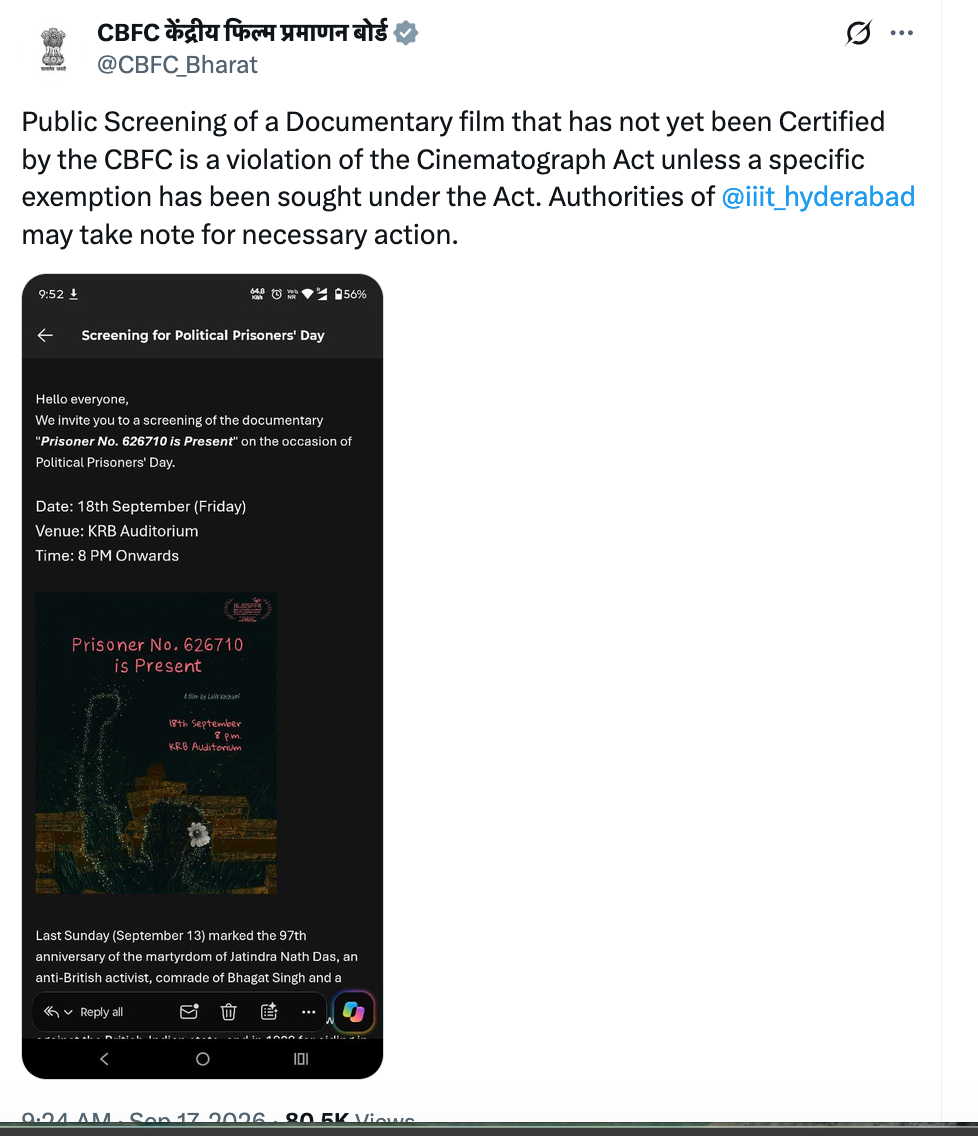
Following the CBFC statement, the institute cancelled a scheduled screening of the documentary “Prisoner No. 626710 is Present” on Sept 18, on grounds that it was unauthorised. Directed by filmmaker Lalit Vachani, the film is on the continued incarceration of student activist and researcher Umar Khalid.
On Sept 13, Umar Khalid completed six years in jail, on charges under the draconian Unlawful Activities (Prevention) Act, 1967, without trial. A bail application that came up for hearing on Sept 21, 2026, has now been deferred to Sept 30, 2026. For the government, any mention of Khalid is anathema and activists who raise slogans and even hold up posters in solidarity are picked up by police.
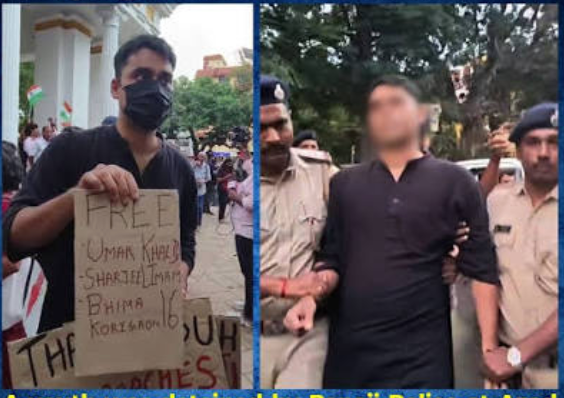
Goa police detain youth activist for holding up a poster demanding the release of Umar Khalid
Khalid’s date of incarceration coincides with Political Prisoners Day, held yearly in India to mark the martyrdom of Yatindra Nath Das, a comrade of Bhagat Singh, who died on Sept 13, 1929, on the 83rd day of a hunger strike in jail, after being force-fed by the British government.
Made in 2024, the film on Umar Khalid has had multiple screenings since. It had not sought a certification from the CBFC. Vachani has made screenings freely available to anyone or any group interested by providing a link to his film uploaded on a video sharing site.
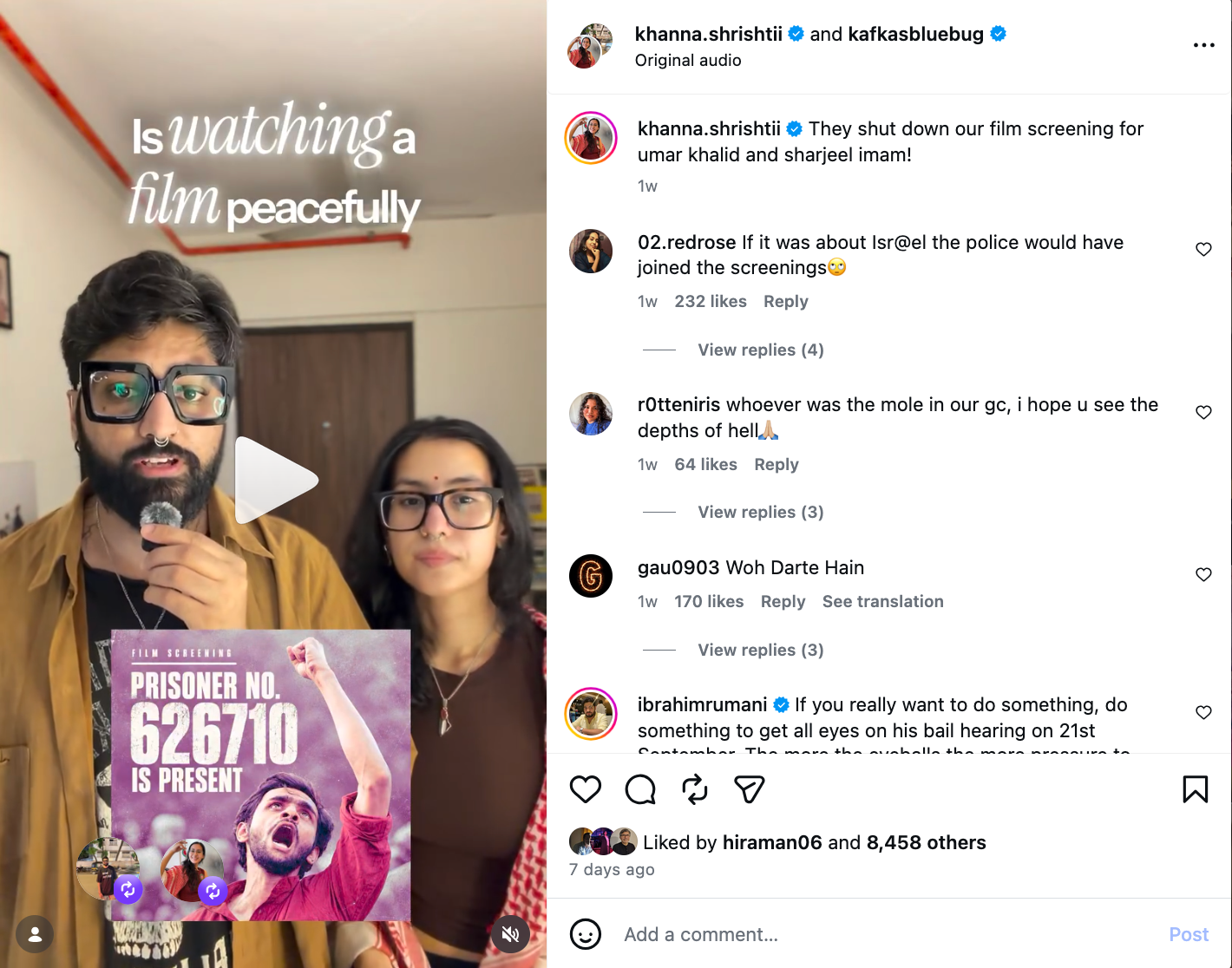
The IIIT-H cancellation was only one of the many cancellations of the film screening in Mumbai and Bangalore. In Mumbai, social media influencers Shrishti Khanna and Prashant Pundhir were unable to find venues to screen the film. They posted on ‘X’ that police got to know of a venue a day before the screening and questioned the owner of a space in the western suburb of Bandra, forcing the latter to back out. Police continued to “raid” the venue even after the screening was cancelled, so as to intimidate people, they said.
In Bangalore a scheduled screening of the film by the Law and Society Committee (LawSoc) of the National Law School of India University (NLSIU) was cancelled following “serious threats of criminal action, intimidation, doxxing and other forms of harassment.”
According to media reports, the decision to cancel the film screening was made by the university administration and student Bar Association after considering the “legal requirements” of a film that did not possess a certificate from the CBFC.
The CBFC and the law on public exhibition of films
Certification for public film screenings in India are governed by the Cinematograph Act, 1952. The act, formulated in colonial India in 1918 primarily to regulate public exhibition for fire and safety purposes, added prohibitions on grounds of public order, morality and was carried over into independent India in 1952, with all the reasonable restrictions laid down under Art 19 (2) of the Constitution.
Film certification is regulated by the CBFC, a statutory body under the Ministry of Information and Broadcasting and is ostensibly an ‘independent’ body to screen and certify films according to age and content. The CBFC’s stated objectives is to ensure that the medium of film remains responsible and sensitive to the values and standards of society; that artistic expression and creative freedom are not unduly curbed; certification is responsive to social change” and that film provide clean and healthy entertainment and are of aesthetic value and cinematically of a good standard.
The board further ensures that the depiction of anti-social activities or violence is not glorified or justified, scenes depicting smoking or consumption of drugs are accompanied by statutory warning and scenes depicting sexual violence are kept to a minimum (read the latest revised guidelines for the entire list).
The CBFC relies on the provisions of the Cinematograph Act to prohibit unauthorised exhibition but clause 6AB prohibits “unauthorised exhibition” of an infringing copy of a film for profit at a place not licensed for exhibition and in a manner that amounts to infringement of copyright. Clearly, the provision of an unauthorised exhibition relates to a screening of a film unauthorised by the copyright owner and screened for profit (ticketed or priced).
So why is the CBFC flexing its muscles and issuing warnings to “prohibit” public screenings without certification? Is it worried that such screenings will bypass its own role as a premier “censoring” authority for films?
CBFC’s Role: Certification or Censorship?
The CBFC’s members are all appointed by the Central government. Over the years, most appointments to the CBFC Board, especially that of the Chairperson, is less to do with cinema and the arts and more to do with politics. Its current Chairperson, Shashi Shekhar Vempati, is a media technocrat, who worked with Infosys, was CEO of the right-wing news portal NitiCentral.com, drove the BJP’s digital media campaign Mission 272+ for the 2014 General Elections 2014 and was former CEO of Prasad Bharti.
Given the subjective nature of the guidelines and the increasing politicisation of the CBFC, the board’s decisions on cuts or certification are not free of either. Living up to its earlier and more popularly known name (the Central Board of Film Censors) and has imposed unreasonable cuts, delayed or refused certification of films on specious grounds, even when they obtain recognition and prestigious awards. Examples abound. “Santosh”, the award-winning film on police brutality and caste violence is denied to viewers in India and even “The Voice of Hind Rajab” , the moving film on the killing of a young Palestinian girl, was initially denied a CBFC certificate.
Feature films have struggled with the excessive demands of the board and the 120 cuts demanded for the film Punjab 95 is a good example. The film was later released as “Satluj” on the OTT platform Zee5 and taken down three days later.
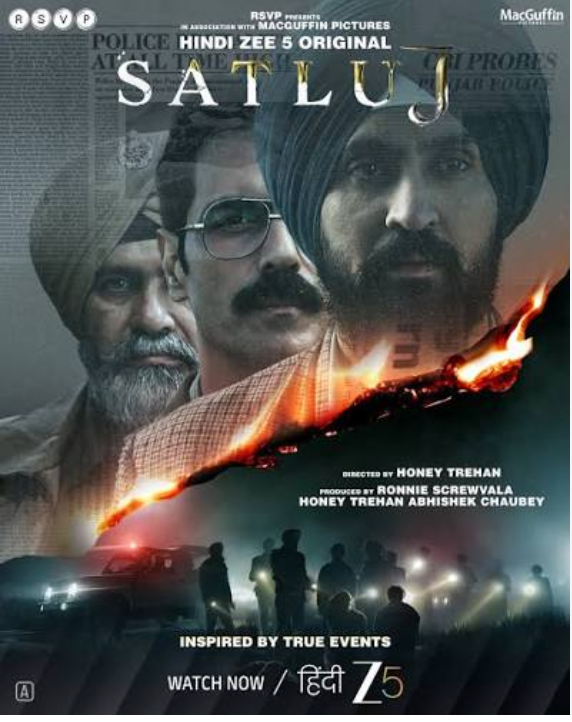
Official poster of Sutluj on Zee5. The film was taken down three days after screening
Even the exemption from certification for films being screened in film festivals is not free from censorship. As many as 31 films were refused exemption for screening at the upcoming International Documentary and Short Film Festival of Kerala, because of their “political content’ and while 23 films secured Union government clearance on the eve of a Kerala high Court hearing, “Sanitised Republic: Cast(e) and Contracts”, on the retrenchment of sanitation workers despite their work in a Delhi hospital during the covid pandemic, is yet to get one.
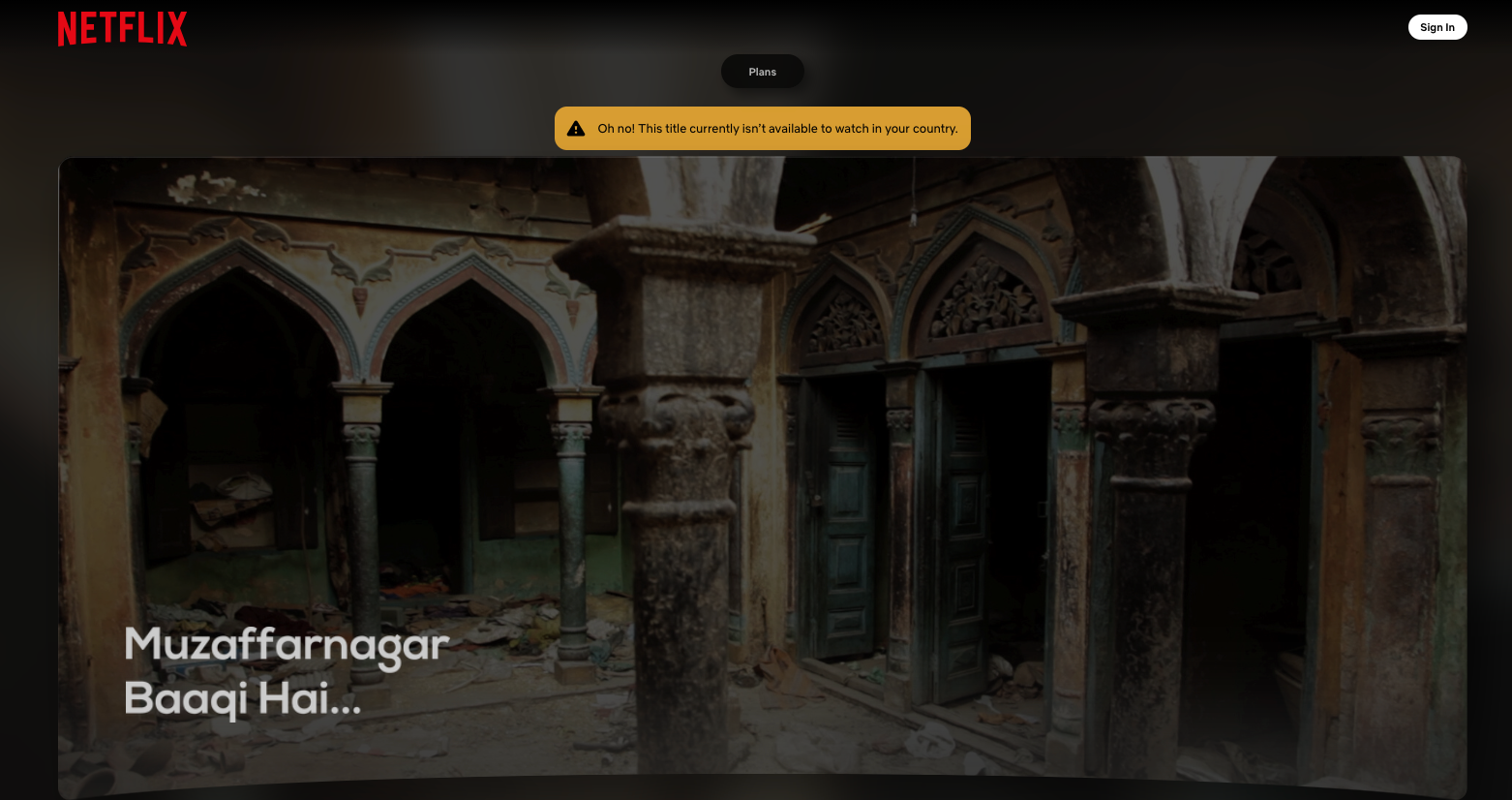
Muaffarnagar Baaki Hai on Netflix: Not currently available in India
Film-makers do challenge CBFC cuts and modifications in high courts across the country. Data available gives us little specifics but a response to a question by Congress leader Mallikarjun Kharge in the Rajya Sabha elicited some information: In 2024-25, 3033 of the 15444 films that received certification, were cut or modified and two films were refused certification. While four films were challenged before a high court in 2024, at least ten were challenged in 2025.
What price, certification?
Documentary film-makers who have faced the brunt of both vigilante and state censorship, have eschewed a painful, prolonged and often futile certification process, preferring to screen their films in private physical spaces, social media or OTT platforms.
Acclaimed film-maker Anand Patwardhan , in a prolonged legal battle, sought accountability from the state for refusing to screen his award-winning film “Father, Son and Holy War”, but, like other film-makers, avoided seeking certification for his later films.
Today, physical spaces, however private, are increasingly unsafe. Right wing forces use violence to disrupt screenings, often under the benign eye of a complicit police force, which totally abrogates its law-enforcing duty. Venue owners or institutional administrators are threatened and harassed. Subjected to intrusive and intimidatory questioning by the police, they often cave in with last-minute cancellations.
When the right of a film maker to make films is available under Art 19 (1) (a), why must the film-maker not have the freedom to show her film to her audience? Why must a film screened for a specially invited audiences, on a ‘not-for-profit’ basis or without any commercial intent and without charging tickets be disallowed as public exhibition?
Despite the threats, there is a pushback, however small. Students at NALSAR Hyderabad, for instance, went ahead with a screening of Vachani’s film. Social media or OTT platforms host the films, despite the threat of take downs due to government notices. After the multiple disruptions of screenings in 2015-16, Nakul Singh Sawhney’s “Muzaffarnagar Baaki Hai”, migrated to Netflix but is unavailable for viewers in India.
Today, as film screenings are sites of protest and resistance, the CBFC warning refuses to take account of a world where the digital melds with the analogue. Given the co-existence of public spheres and private spaces, there needs to be a serious rethink about the CBFC prohibition on film screenings organised for an informed audience, in a ‘not-for’profit’ space which the general public would not have unrestricted access to.
While the overall censorship of films in a majoritarian state is already a given, criminalising and penalising a select public for wanting to view films that spark discussion, debate or even dissent in a collective space, further undermines the right to freedom of speech and expression and must be stiffly resisted.
Related

Commentaries