
Erasing the Poor, Monetising the Land: Mumbai’s Demolition Drives
The use of terms like “encroachers” and “illegal” slums dominate media reports and erase the reality of the lives of the poor and the state’s role in rendering them invisible, says Shweta Damle
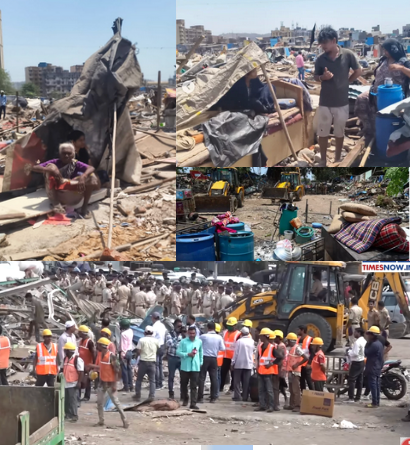
Collage of images from demolition sites (Courtesy Mumbaitoday.news, TimesNow and Indian Express)
In the last one month, three major anti-encroachment drives have taken place in Mumbai.
The first was carried out along the Ghatkopar-Mankhurd Link Road. Around 1,400 homes were bulldozed in what was described as the largest single-day demolition drive in recent years. Nearly 11 acres of government land were cleared of encroachments.
On 12 May, the second demolition drive took place at Darukhana on land belonging to the Mumbai Port Authority (MbPA). Around 100 homes were demolished.
The third demolition was carried out in Garib Nagar in Bandra East. Garib Nagar has been embroiled in a conflict between the Western Railway and the Municipal Corporation since its inception. Approximately 2,000 households and commercial units occupied the 5,200 square metres of railway land adjacent to the tracks and along the water pipeline.
In all three cases, the language of “encroachment removal” masks a larger restructuring of urban land for future capital-intensive use. These encroachments existed for decades with tacit state acceptance — residents had access to electricity, water connections, voter IDs, ration cards, and political patronage — but became “illegal” once the land acquired strategic or commercial value.
Another striking similarity is the selective presence of the state. In all three locations, authorities neglected to provide basic amenities and regular services, yet displayed overwhelming administrative and police presence during evictions.
Equally significant is the complete disenfranchisement of residents who otherwise possess documents proving citizenship and long-term residence. The moment they are categorised as “encroachers,” their legitimacy within the city itself becomes suspect. This becomes even harsher in the context of ongoing documentation and enumeration exercises, where demolition and displacement can effectively erase people administratively as well as spatially.
The deepest similarity, however, is that all three settlements housed workers essential to Mumbai’s economy: transport workers, dock labourers, scrap workers, domestic workers, railway-linked workers, and small vendors. Yet their presence continues to be treated as temporary or illegal, even after generations of residence.
Perhaps the most disturbing similarity across all three sites is the sheer visibility of social abandonment. Children and women sift through rubble searching for clothes, utensils, schoolbooks, and identity documents. Men salvage blankets, iron rods, wooden planks, and anything that can be repurposed or sold. Others sit silently beside the debris of what was once their home, unable to process the violence of sudden dispossession.
How “legal” was the demolition process?
In Ghatkopar-Mankhurd Link Road, notices were served on 18 February 2026, and residents were given seven days to vacate. Multiple coordination meetings were held with the BMC’s M-East Ward, more than 10 JCBs were deployed, and heavy police deployment accompanied the single-day demolition drive. The government has since cleared the land, but no final plan has been announced for the parcel. Proposed uses have ranged from detention centres to science parks. Mumbai Suburban Collector Saurabh Katiyar stated that satellite imagery was used to identify the extent of encroachments that had come up after 2011.
In Darukhana, the MbPA served notices to nearly 120 households along New Tank Bunder Road on 17 April 2026. Authorities described the settlements as “unauthorised encroachments” and cited “security threat” concerns because the area lies close to port infrastructure. On 28–29 April, nearly 400 residents formed a human chain and blocked access to the area, resisting initial demolition attempts.
A second demolition attempt was undertaken on 12 May under heavy police deployment involving nearly 500 personnel. Around 100 homes were demolished, reportedly displacing nearly 500 residents, including children and elderly people. Bulldozers entered early in the morning while police had reportedly been stationed overnight. Many residents claim to have lived there since before 1995 and possess entitlement documents. However, rehabilitation claims cannot automatically be applied because the land belongs to the central government. Both ruling and opposition party leaders reportedly gave assurances after the first demolition attempt, but ultimately, the residents did not receive any relief. Demolitions on port land have occurred periodically, though residents are often later allowed to resettle.
The Garib Nagar slum cluster sat directly at the intersection of Western Railway property and the BMC’s vast water infrastructure — the vital Tansa water main pipeline. The expanding settlement has historically encroached upon portions of land owned by both authorities. In the early years of the slum’s existence, it regularly faced eviction notices from the Western Railway and the local ward office. Political backing often stalled the evictions. Older residents recall former MP Sunil Dutt resisting mass evictions. Following demolitions, kuccha structures would often reappear and continue to exist until the next eviction drive.
On October 26th, 2017, the High Court ordered the removal of encroachments within 10 metres of Mumbai’s main water pipeline. The municipal corporation arrived with a heavy police escort and bulldozers. Hours into the demolition, a massive Level-IV fire broke out, engulfing the entire area. A subsequent police investigation claimed that a resident had initiated the fire to delay the evictions. Following the fire and subsequent court proceedings, a large portion of the land remained under litigation. In 2022, 148 structures were demolished to protect train operations and minimise waste dumping on railway tracks. On 19 May 2026, the High Court’s final order was executed. Led by the Western Railway Engineering Division and backed by over 1,000 personnel from the Railway Protection Force and Mumbai Police, the demolition drive targeted nearly 400 unauthorised multi-storey structures. The High Court ruled that only 100 surveyed ground-floor structures would remain protected pending alternative housing arrangements.
The common thread in all these demolitions
It has been my observation, while working in slums, that settlements as precarious as Garib Nagar are allowed to exist only as long as they remain visibly contained. Once they expand and begin to appear overbearing, eviction drives are initiated. This reflects the acute shortage of housing for economically weaker sections and lower-income groups. It also shows that migrants have no space in the city; if they come to Mumbai, they must fend for themselves, especially for housing.
Demolitions carried out during the peak of summer have further exposed the profoundly uncaring character of the city’s governance structure. The nexus between political authorities, infrastructure agencies, and capital increasingly operates through displacement and land clearance, while showing little concern for the lives being uprooted. New migrants and recently-settled families are the most vulnerable, as they often possess neither savings nor stable social support networks. In many cases, the distress of displacement extends across entire communities, leaving even support systems unable to cope.
These demolitions also create sudden pressure on rental housing markets in neighbouring working-class areas. Increased demand for low-cost accommodation pushes rents upward and often prices out the evicted population itself. The unregulated informal rental market becomes even more exploitative under such conditions, marked by overcrowding, insecure tenure, arbitrary rent increases, and coercive landlord practices.
Why did these demolitions take place?
In all three cases, demolitions were justified in the name of infrastructure expansion, safety, or urban improvement.
Along the Ghatkopar–Mankhurd Link Road, 11 acres of revenue land were reportedly handed over to the Central Jail Authority on May 15 for the construction of a detention centre intended to ease pressure on existing prisons.
In Garib Nagar, the demolition has been linked to the expansion of Bandra Terminus, increased railway operational capacity, and the monetisation of valuable railway land. Authorities claimed the cleared land would support additional train services and station redevelopment.
In Darukhana, working-class settlements and informal economic spaces have repeatedly faced pressure due to port redevelopment, road expansion, and attempts to transform the eastern waterfront into higher-value urban real estate.
Mankhurd, Darukhana, and Garib Nagar illustrate a larger transformation underway in Mumbai:
• from a city that informally absorbed labouring populations,
to one increasingly driven by land monetisation, infrastructure corridors, and speculative redevelopment.
These demolitions are therefore not isolated “anti-encroachment” actions but part of a broader remaking of urban spaces, in which the poor are tolerated when their labour is needed and displaced when land values rise.
What emerges is an increasingly exclusionary and structurally uncaring city — one that depends on the labour of the poor while denying them security, shelter, and permanence within the urban landscape.
(Shweta Damle is the founder and Director of Habitat & Livelihood Welfare Association and on the Executive Committee of the Working Peoples’ Coalition. She is based in Mumbai).
Related


Commentaries