
File FIR First: Why is Delhi Police stalling Independent Journalist Rosy?
Rosy has been struggling for two months to get the Delhi police to register an FIR relating to sexual assault by one of its own officers. Meanwhile NWMI’s judicial intervention has provided her with protection against police coercion. Revathi Siva Kumar* tracks the case.NWMI – Rejoinder (21.11.2026) POLICE COUNTER AFFIDAVIT 1361
Independent journalist Rosy’s attempt over the past couple of months to ensure the registration of a First Information Report (FIR) with regard to alleged sexual assault by Assistant Commissioner of Police (ACP) Vivek Bhagat, of the Delhi Police, will come up before the Patiala House Court in the capital on 1 December 2026.
This is expected to be an important procedural step in her continuing fight to get the FIR registered against ACP Bhagat for sexual harassment and assault. Even though the Delhi Police has been resisting doing this since 3 October, the day she was allegedly molested by Bhagat, Rosy remains hopeful. “Ummeed tho nahin chod sakthe na, ma’am (one cannot give up hope, right, ma’am),” she sighs.
“We have moved under Section 175(3) to file an FIR,” affirms Vertika Mani, her lawyer. She is confident that it will indeed get registered since the matter involves such a “grave allegation”. The court has already ordered an action taken report and preservation of evidence. The police are expected to submit the report on 1 December.
“We are just asking the police to go ahead with gathering evidence and doing a preliminary investigation,” Mani adds. “We are fully cooperating with the authorities every time they give us a date for investigation. Strangely, they have asked us to fill a questionnaire. But we have completed that, too! Since the police have the CCTV footage, we have cooperated with everything regarding the preliminary investigation.”
Charged with a counter-charge
Paradoxically, the accused police officer, ACP Vivek Bhagat, filed a counter-charge ten days after the protest and his FIR was registered immediately. “How was his FIR registered within just 26 minutes when his complaint was filed after so many days?” asks Mani, wryly. “Bhagat’s case is weak; it was filed only to browbeat and intimidate Rosy and pressurise her family.”
The hearing in that case, which accuses Rosy of using ‘casteist slurs’ against Bhagat, is scheduled for 8 December. On the other hand, it is only after an FIR based on Rosy’s complaint of sexual assault is registered that the investigation can be undertaken. According to Mani, there seems to be delay by the Delhi Police to register the first step on her behalf.
Nevertheless, Mani is convinced that Rosy’s case is strong and says she will not give up on the effort to get justice for her. According to her, the writ petition filed by the Network of Women in Media, India (NWMI) in the Supreme Court on 12 October has been of “immense help” in preventing police coercion against Rosy (details below).
The timeline
Rosy’s ordeal began two months ago, on 3 October, when she was covering the public protests against the Election Commission of India’s Special Intensive Revision (SIR) of electoral rolls outside Jantar Mantar in Delhi. She questioned the absence of policewomen at the point where Neha Bora, national president of the All India Students’ Association (AISA), and other women protestors were being detained. ACP Bhagat reportedly responded to her legitimate query with sexual assault, allegedly pressing her breast and pushing her.
In response, Rosy grabbed his uniform and shouted, asking how he could misbehave while wearing his uniform. According to her, Bhagat – the “darpok (coward)” – then ran away. She tried to film what was happening, but Bhagat retreated to a police van, where several male constables were present. Soon, a number of female constables joined them and surrounded the journalist, blocking her from directly confronting Bhagat for his behaviour.
Rosy and her colleagues then went to the Parliament Street Police Station to file a complaint and get an FIR registered. Since the complaint was not registered, they remained at the police station. Their sit-in continued through the night and into the next day. Rosy said that three doctors had examined her and confirmed that she had a mark on her right breast. Since it was painful, she was given an injection for pain relief. As the Medico-Legal Certificate (MLC) procedure was completed, Rosy said that the FIR should be registered, but the police told her to wait till the next day.
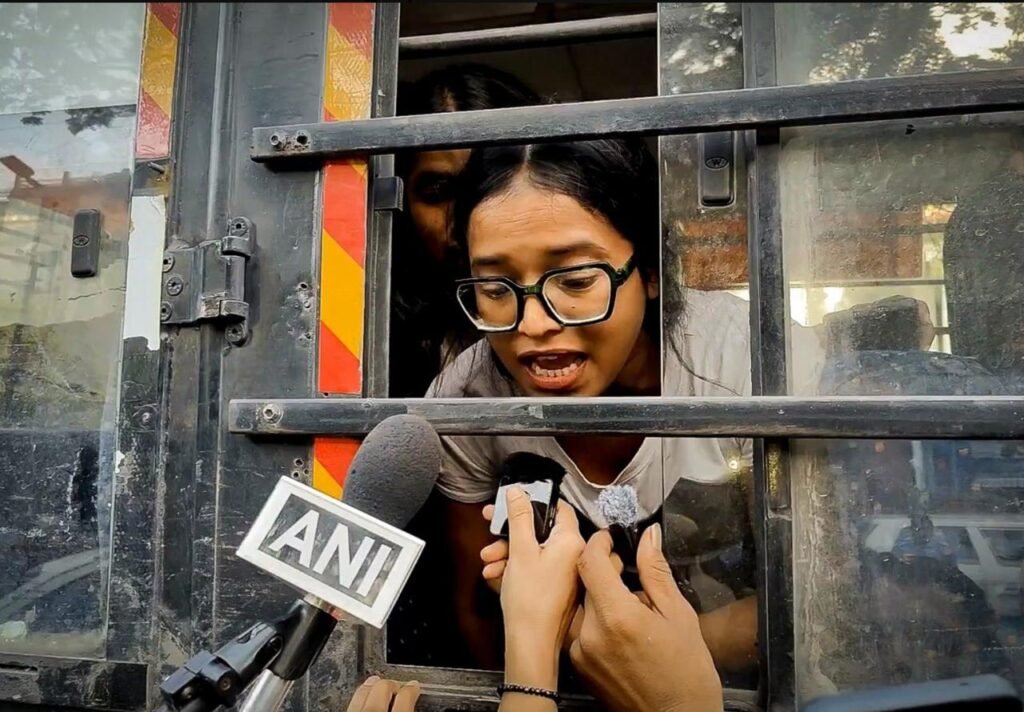
Journalist Rosy, detained by Delhi police on Oct 5, 2026, along with other journalists who were demanding the registration of an FIR against ACP Vivek Bhagat on charges of molestation (Image Credit: X/Yogendra Yadav)
4 October
The main purpose of the sit-in was to demand that the Delhi Police register the FIR against ACP Vivek Bhagat by noon. However, the case was transferred to the Crime Branch for an enquiry and preliminary investigation, as a senior officer was involved.
Hence, the protests began by evening and continued through the night. They were joined by other journalists, activists and supporters, including CPI(M) leader Brinda Karat and Saurav Das of the Cockroach Janta Party (SJP).
5 October
At about 7.30 am on 5 October, the police detained about 20 protestors. Rosy said that she was again assaulted by the police. Female police women verbally abused her, dragged, pinched and pulled her hair. Male officers also pushed many of them. The detainees were transported to the Delhi Police camp in Delhi Cantonment, where an FIR was registered against 17 of the protestors, though Rosy was not included in the FIR. She another protestor were taken separately for a medical examination, though it was delayed. No medical treatment or MLC was given.
Despite the case being handed over to the Crime Branch, Delhi police questioned the authenticity of the CCTV image of the incident, claiming that it was AI-generated. They even went so far as to arrest a 24-year-old YouTuber from Haryana, Nadeem Ahmed, who had allegedly circulated it. Police claimed that other accounts that allegedly circulated an image are also being identified.
The Delhi government issued an order regarding the current duty charge of the post of Additional Deputy Commissioner of Police, assigned to 12 officers of the Delhi, Andaman and Nicobar Islands Police Service (DANIPS), including Bhagat. This was modified the next day and ACP Bhagat’s name was taken off the list, purportedly at his request, until a full enquiry into the allegations had been satisfactorily conducted and concluded.
13 October
The NWMI’s writ petition in the Supreme Court, filed on 12 October, was mentioned in the court on the 13th by Senior Advocate Indira Jaising, who represented the network. The petition highlighted the assault and arbitrary detention of journalists by Delhi Police personnel during the anti-SIR protests in the capital and raised, in particular, the issue of women journalists, who were subjected to physical handling, dragging, detention and confinement.
At around the same time, ACP Bhagat decided to file his counter-charge, claiming that Rosy and another journalist Gajendra Singh had used casteist slurs against him, causing him mental distress and damaging his professional and personal reputation. According to Bhagat, at about 2.30 pm on 3 October, Rosy identified him by his caste (Megh/Meghwal scheduled caste) from his name tag and made caste-based derogatory remarks against him while alleging in front of the assembled crowd that he had sexually assaulted her. His version of the incident claims that, subsequently, five others among those present at the scene “ambushed” him.
While no FIR was registered by the Delhi Police on the basis of Rosy’s 3 October complaint against Bhagat, an FIR was promptly registered on the basis of the police officer’s 13 October complaint against Rosy and Singh.
Bhagat’s FIR, registered under the Scheduled Castes and Scheduled Tribes (Prevention of Atrocities) Act 1989, along with sections 221, 356(2) and 3(5) of the Bharatiya Nyaya Sanhita, covers obstruction, defamation and common intention.
Rosy has categorically denied the allegation and says that she did not even know his name at the time and cites the clear evidence in all the videos filmed on the spot. Only later, when she chased and identified him as her harasser, did she see his name on his badge. That incident was filmed and used by Bhagat to charge her of using casteist slurs to denigrate him.
Clearly, Bhagat’s counter charge was meant to deflect the issue, Mani opined, adding that she is convinced Bhagat’s case against Rosy is weak. Rosy herself belongs to the Khasi Lyngdoh (scheduled tribe) community and is, therefore, excluded under Section 3(1)(r) and 3(1)(s) of the SC/ST (Prevention of Atrocities) Act.
15 October
During the hearing of the NWMI petition on the 15th, the Supreme Court granted Rosy interim protection, directing that the Delhi Police should take no ‘coercive action’ against her in connection with the FIR based on ACP Vivek Bhagat’s complaint.
16 October
Senior Advocate Tanveer Ahmed Mir, counsel for Rosy in the challenge to the FIR registered on ACP Bhagat’s complaint, approached the Delhi High Court to get an immediate stay on the investigation into the FIR based on the SC/ST Act against Rosy. He argued that Bhagat’s complaint was retaliatory. However, the court declined to stay the investigation.
3 November
Rosy approached the Patiala House Court one month after initiating her complaint, pointing out that the Delhi Police had failed to register an FIR over a whole month and requesting judicial intervention. The court asked the Delhi Police to submit an action-taken report and also ordered the preservation of evidence, including CCTV footage and police body-camera recordings.
1 December
Rosy’s case regarding the non-filing of an FIR based on her October complaint is due to come up in the Patiala House Court on 1 December.
While neither the police nor the courts have offered Rosy much hope so far, she refuses to give up. “What is the use of the police wearing the vardi (uniform) if they use it to harass the public, the very people they are supposed to protect?” she asks.
She is firm that she will continue to fight against the hegemony of the state, the custodian of safety. “I’m not giving up hope,” she repeats. “I would have excused Bhagat if he had given some apology. Maybe the case would not even have become so big if he had apologised, but it got serious when he refused to.”
Meanwhile, the Delhi police, in its counter affidavit in the contempt petitions filed by the Network of Women in Media, Free Speech Collective, Delhi Union of Journalists, and the Kerala Union of Working Journalists, defended its action and stated that while it did not curb professional journalists, “reel-makers, influencers or unruly elements” were not exempt from the general law or lawful directions at the site of a prohibited assembly.
In its rejoinder, the NWMI has strongly refuted the claims of Delhi police and stated that police cannot bypass constitutional protections for personal liberty under Article 21, simply by labeling their actions as “crowd control” or “removal for verification” rather than “detention” or “arrest”. The NWMI rejoinder states that “crowd control is not a zone in which a woman’s dignity and bodily integrity stand reduced”.
The next hearing is scheduled on 23 November.
(Please read the Delhi police counter affidavit and the NWMI rejoinder.)
(*Revathi Siva Kumar is a journalist based in Bengaluru, India. She is a member of the Network of Women in Media, India (NWMI). This report is jointly published by NWMI and Free Speech Collective)
Related

Commentaries