
In Goa, a journalists’ union list on “legitimate” media gets state government approval
Can a journalists’ union collaborate with the state government to decide about “shady” and “legitimate” media, asks Frederick Noronha*, concerned about the dangerous implications of such exclusions for media freedom.
A proposal by the Goa Union of Journalists (GUJ) to draw up a list of “duly registered media organisations” operating in Goa has sparked debate over the role of a trade union in determining which media outlets qualify for recognition. While the stated aim is to curb the proliferation of unregistered publications and self-styled journalists, the initiative has also raised questions about its implications for press freedom, union membership and professional representation.
The GUJ first outlined the proposal in a press statement issued at its annual journalism awards function on June 9, 2026. The proposal was described as “a move to promote accountability, transparency and professionalism” within the media fraternity.
The GUJ is Goa’s largest journalists’ trade union and has been active in the state since the late 1970s. The proposal itself was subject of several debates in union meetings last year. The decision to compile a list of GUJ-recognised media organisations in Goa was taken at the GUJ Annual General Meeting 2025 and executed by the GUJ executive committee. This commentator was there for that meet; and the wisdom of the move was debated inconclusively.
With the expansion of the media and its overtly partisan approach, the jostling within Press and digital media ranks has turned out to be more contested. While some mediapersons have accused “YouTubers” of blocking genuine media space, the newer entrants to the field have questioned what they see as restricted access to the Fourth Estate as a whole.
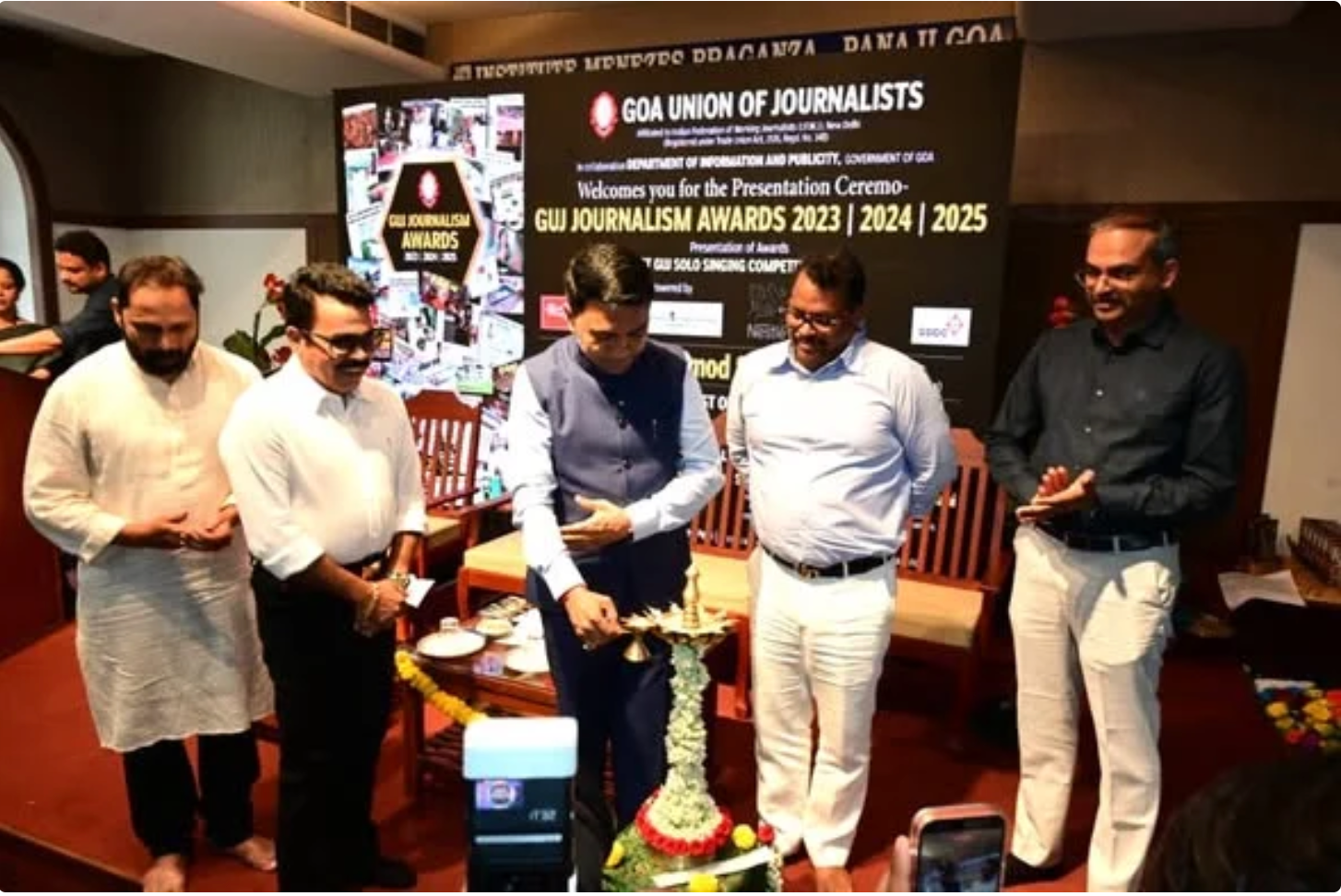
Goa Chief Minister Dr Pramod Sawant sought a check on ‘shady’ journalists and welcomed GUJ list of media organisations
Unsurprisingly, the move was welcomed by Goa Chief Minister Dr Pramod Sawant, who said there was “a need to streamline activities of unregistered media organisations operating from the state, so that fly-by-night operators do not create chaos during the upcoming 2027 assembly polls…” Dr Sawant also pledged that the state government would adhere to the “list” when “releasing government advertisements, publicity material, invites to state events and all other purposes.”
GUJ’s 35 media organisations in the “List”
In its run up to the union elections, held on June 27, 2026, the union explained its logic: “In order to regulate and bring accountability to the increasing number of self-proclaimed journalists, digital news channels and online portals functioning as mainstream media in the state, GUJ has been working closely with the [Goa Government’s] Department of Information and Publicity towards effective implementation of the Goa Media Representatives Accreditation Rules 2025. As a step forward, GUJ has come up with a list of GUJ-recognised media organisations.”
The GUJ list has 35 media ogranisations on it. Media organisations where there is no GUJ representation have not been included. If working journalists employed at any of the non-listed media organisations take up GUJ membership, their names would be added, the union promised.
Under the union’s rules, one needs to be a “working journalist”—someone who earns a substantial part of their livelihood from journalism—to qualify for membership. The new requirement that members represent “duly registered media organisations”, however, could create an additional barrier to joining the union, particularly for journalists working with smaller, newer or independent media outlets.
GUJ members representing media organisations that have not submitted their registration details and failed to comply within the stipulated deadline have been placed “under consideration”. Their names will not appear in the GUJ voters’ list. However, they will continue to remain as GUJ members, subject to submission of media organisation registration details, before the self-declaration process in 2027, the union added.
It added: “The initiative aims to curb the trend of self-proclaimed journalists and mushrooming of unaccounted and unregistered media organisations in the state. The move also aims to promote greater accountability, transparency and professionalism within the fraternity.”
Accreditation: when a journalists’ union “collaborates” with the state
In his General Secretary’s report for 2025-26, Vasudev Pagi, the outgoing General Secretary of the GUJ said that the “objective of preparing the provisional list is to strengthen the credibility of journalism in Goa, ensure compliance with the Goa Media Representatives Accreditation Rules, 2025, and establish a transparent and accountable framework for recognising genuine media organisations operating in the State.”
This however raises governance questions, such as (i) What criteria were used? (ii) Is there an appeal process? (iii) Could recognition affect their operations, or their credibility in the marketplace? If so, it could be stressed, transparency in the process becomes important.
For some, this writer included, it is a matter of concern that members of the media are inviting the State to decide on the legitimacy or otherwise of the media. If politicians set the agenda on who are “shady” journalists, without laying down well-defined criteria, that would be problematic.
Besides, it appears to confuses the real problem of unethical journalism with the far more dangerous idea of allowing the government and a small number of journalists to decide who counts as “legitimate” media, and on what grounds.
Journalism is not a licensed profession in India. In fact, some of the most important reporting in recent decades has come from small publications, independent websites, freelancers, citizen journalists and new media ventures that may not fit neatly into a list of “recognised” organisations.
Currently, like in the rest of India, in Goa too, journalist accreditation is an official recognition granted by governments or authorised agencies to journalists. Accredited journalists are typically entitled to attend official press conferences, access government offices and legislatures, receive official press releases and notifications, and, in some cases, avail of logistical benefits such as press rooms or travel concessions.
But, accreditation does not grant special legal privileges, immunity or the right to publish. It is also not a mandatory requirement to practise journalism. Instead, it has been justified as a credential that helps verified media professionals carry out their reporting more effectively, particularly when covering government and public institutions.
Interestingly, India’s formal press accreditation system came about towards the end of the colonial period. It was given institutional status after Independence, with the Press Information Bureau setting up a structured accreditation in the early 1950s to regulate media access to the Central Government.
Currently it is used both by the Centre and State governments, and facilitates official access. Yet, it sometimes gets faulted for creating a proximity between journalists and government and encouraging self-censorship. It can also been seen as creating a system which benefits the corporate media over freelancers, digital journalists or smaller regional publishing. Accreditation can be used to reward favourable coverage or penalising critical reporting
Over a hundred countries in the world are believed to have Press accreditation systems in place. But while some use it as an administrative tool for access and security, in more restrictive political systems it is known to be used as a means of controlling or influencing the media.
Role of a journalist trade union
The mechanism adopted raises questions about fairness, independence and the role of a trade union. Its primary task is to represent workers, not to license or certify employers.
The criteria themselves are also problematic. Inclusion depends initially on whether a media organisation has GUJ members. In other words, a publication without union members is excluded irrespective of its legal status or journalistic credentials. This circular reasoning means “recognition’ depends on existing union representation.
The link between organisational compliance and an individual journalist’s voting rights is also concern-causing. Journalists may lose their place on the GUJ voters’ list because their employer has not submitted registration documents; the journos have no control over management decisions. Trade union rights are attached to workers, not employers.
Finally, the rules appear to offer limited safeguards regarding appeals, review and transparency. Conflating the tasks of protecting the rights of working journalists, regulating media organisations, and curbing the voting rights of some, might not be such a good idea. It could weaken the independence that journalists’ organisations are meant to uphold.
Shamiro Diniz, programme executive-presenter at CCRTV, while commenting on a local media discussion group, argued: “Traditionally, … a journalist/reporter worked for newspapers, TV channels, radio, or news agencies like PTI, UNI. Today, with the introduction of social media, the field is much broader. I have seen people mushrooming during elections running around with mobiles on a selfie stick. Definitely it’ll be unfair if the Government or anybody goes about certifying anyone as a press/media person. The only qualification that truly matters is a commitment to truth supported by integrity, competence and the courage to hold the power accountable, not ar*e lick it. The topic is broadly debatable.”
Senior journalist and former deputy editor with the Herald in Goa and editor at Himal at Kathmandu, Vidyadhar Gadgil, commented: “It is a really bad idea to allow the government to become the adjudicator of issues like this. Who is the CM to decide which journalists and publications are “shady”? GUJ must oppose all such efforts. Shady in government-speak means those who write things that the powers-that-be don’t like.”
*Frederick Noronha has been a journalist since the age of 19, some 43 years ago. He has a PhD in publishing in the Goa of the 20th century, and has edited two books on the media in Goa. These are titled ‘In Black and White -Insiders’ stories about the press in Goa’ and ‘And Read All Over’. The first is available as a free download on archive.org.
Related

Commentaries