Protesting Through an Internet Shutdown – The Limits of Staying Connected
Communication, documentation, and access to assistance have been shut down during peaceful protests. Rohini Lakshané breaks down the practical, technical, and legal limits of staying connected during Internet shutdowns and says that while preparedness can reduce harm, it cannot replace state accountability for restrictions on communication and assembly.
On 9 October 2026, authorities ordered the 24-hour suspension of mobile internet services in a certain area in New Delhi. The shutdown ran for 24 hours coinciding with the time the Cockroach Janta Party (CJP) planned to protest at Jantar Mantar. Delhi Police requested the suspension, citing concerns about public disorder. The Union Home Secretary approved the request and later defended it as necessary and proportionate in an affidavit before the Supreme Court. He also clarified that the suspension did not extend to fixed broadband or Wi-Fi.
Connectivity restrictions can prevent protesters and journalists from sharing material, including evidence of incidents at a protest. People need communication to coordinate an assembly, find a missing companion or someone who has been detained, contact a lawyer or family, or arrange medical assistance. A shutdown can obstruct several of these activities at once, increasing uncertainty for people beyond the protest site as well. Restricting access to tools used to verify information can also make rumours harder to counter, potentially undermining the government’s stated objective of preventing public disorder.
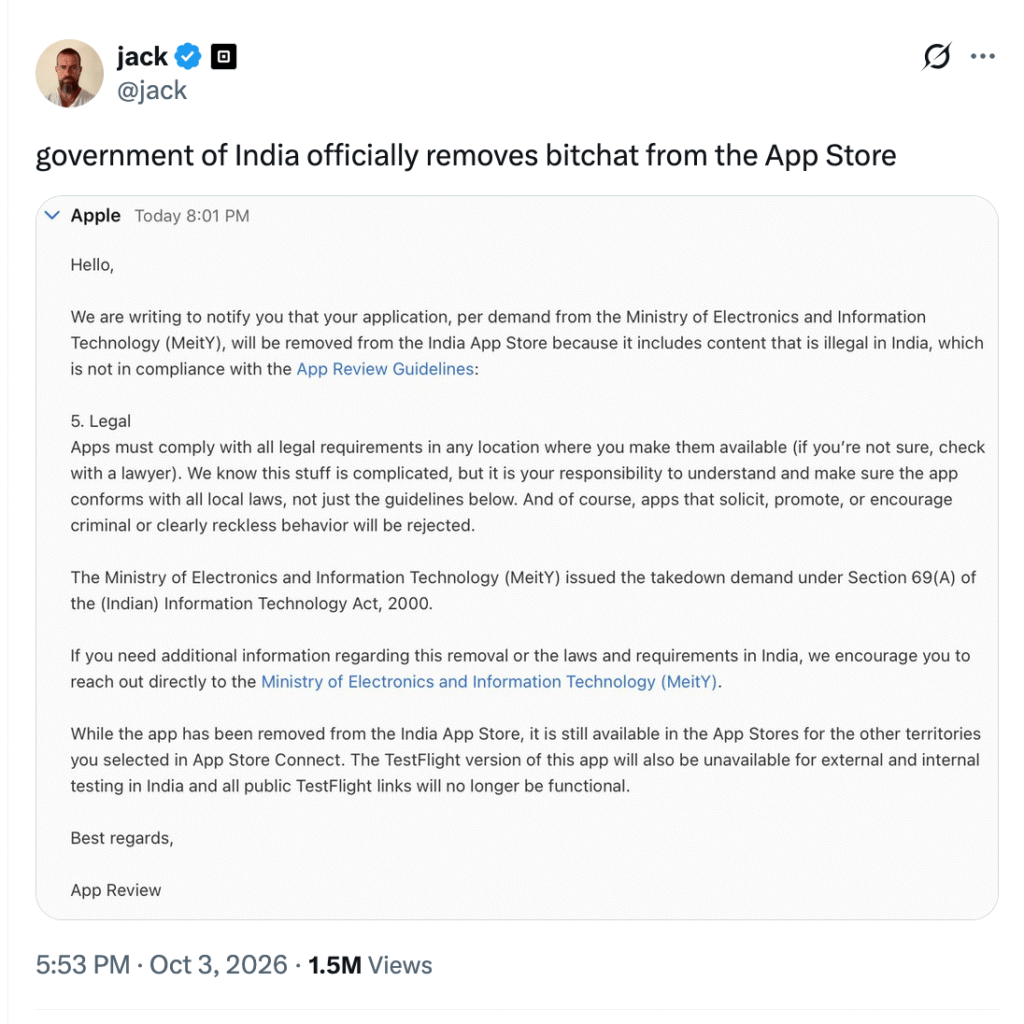
Bitchat was unavailable on play stores in India (Jack Dorsey on ‘X’)
On 3 October 2026, the Internet Freedom Foundation reported that Apple had removed BitChat from its Indian App Store following a demand from the Ministry of Electronics and Information Technology under Section 69A of the Information Technology Act, 2000. The application’s TestFlight builds were also unavailable in India. The Foundation said the underlying blocking order had not been published.
(Ed’s Note: SFLC.in, representing Appropriate Technology Promotion Society, has challenged the block in the Kerala High Court.The government has been directed to give its response within. four weeks).
These interventions restrict communication in different ways. An internet shutdown limits connectivity within an affected area; an app-store restriction limits the distribution of a particular tool (Access Now, 2024; Internet Freedom Foundation, 2026). Both can hinder organising and information-sharing, including before an assembly takes place. Removing an application from a store, however, does not necessarily disable copies already installed on users’ devices.
Internet shutdowns have repeatedly been imposed in India in connection with protests and anticipated public unrest (Access Now, 2026; Internet Society Pulse, 2026). The practice forms part of a broader pattern of restricting communications during politically sensitive events, although the stated grounds and scope of individual shutdowns vary.
The practical question is which communication functions remain possible under a particular restriction. Losing connectivity, being unable to install an application, and being unable to access an online service require different responses. Each alternative must be assessed against the task it is meant to support and the demands it places on its users.
Communicating when networks fail
No application can restore internet access when every route to the internet has been cut. Some tools can still connect nearby devices, store information for later transmission, or use a connection that remains operational. Local communication and delayed delivery can be useful, but neither guarantees contact outside the affected area. (See Shutdown.tools and WITNESS — File Sharing and Communication During an Internet Shutdown.)
Redundancy means arranging a backup that survives the failure affecting the primary means of communication. During a protest, an application may become unavailable, a network may be disconnected, or a phone’s battery may run out. A working alternative connection, backup power, and an offline communication plan address different failures. Identifying these dependencies helps establish what each backup can preserve.
The following examples distinguish the failure a backup can address from the vulnerabilities that remain.
| Backup | Failure it can address | Remaining vulnerabilities |
|---|---|---|
| Alternative messaging application already installed | One messaging application becoming unavailable | Both applications may depend on the same internet connection |
| SIM cards from different operators | Uneven network coverage or an operator-specific outage | A shutdown covering every mobile operator; dependence on the same handset |
| Existing fixed broadband alongside mobile data | A shutdown affecting mobile internet only | Broadband also being disconnected, inaccessible, or unpowered |
| Tested Bluetooth or local Wi-Fi messaging | Loss of cellular connectivity between nearby participants | Distance, missing peers, device compatibility, and battery loss |
| Backup power and essential information stored offline | Battery depletion or inability to retrieve contacts, maps, and instructions | Loss of the device or information itself |
Redundancy also includes people and procedures: predetermined meeting points, agreed check-in times, a designated contact, a plan for responding to missed check-ins, and essential information stored offline. These arrangements can help participants coordinate, locate missing people, and obtain assistance when telecommunications fail.

No connectivity during July 2026 NEET protests (‘X’ @Saurabh_MLAgk)
The July 2026 NEET protests in Delhi offer examples of such preparation. A participant told AFP that she and her friends had agreed where to meet before leaving home because they anticipated network interruptions at the protest site. CNA also reported that protesters and volunteers circulated checklists advising participants to download maps for offline use, save emergency contacts, and carry power banks. These preparations reduced dependence on connectivity for finding a meeting place and accessing essential information.
People anticipating a shutdown can use the following preparedness checklist:
- Establish what connectivity still works. Mobile data, fixed broadband, voice calls, SMS, and local wireless links may be affected differently. Communication outside the area requires a route that remains operational.
- Rely on demonstrated capabilities. Test tools beforehand on the devices and software versions people will use. A successful nearby test establishes that connection at that time; it does not establish reliable coverage or delivery as participants move or conditions change.
- Identify the failure each backup covers. Different applications or operators may still depend on the same disabled connection, handset, or power source.
- Match the task to the available connection. Nearby coordination, urgent requests for assistance, transferring evidence, and publishing video have different requirements. Delayed delivery may preserve a document while being inadequate for an urgent request for help. Check whether the application distinguishes queued messages from confirmed delivery.
- Assess the exposure created by communication. Consider who can read messages, verify senders, observe participation, or access information stored on devices. Encryption alone does not establish that a tool is suitable for its users.
Lessons from earlier internet shutdowns
A study I co-authored in 2018 documented how unreliable mobile connectivity and intentional internet shutdowns affected work, activism, and personal safety of women in Manipur. Communication failures delayed crisis intervention and complicated the collection of information and evidence in cases involving violence against women. Participants in the study used multiple SIM cards and mobile devices to compensate for uneven network coverage in different areas. Some even travelled to a neighbouring state to be able to access the internet for important commitments.
These measures establish redundancy as an existing coping practice, with its usefulness varying by circumstances. Digital skills varied, familiar communication services remained important despite surveillance concerns, and the study identified a need for digital-security training. These findings show how much a workaround can demand of its users: another connection, another device, money, time, technical knowledge, skills, or the ability to travel. Maintaining equipment and using it during an emergency added further demands. Many affected people cannot meet these costs. The study was exploratory and did not audit contemporary circumvention apps.
Research I co-authored with Prateek Waghre in January 2020 on internet restrictions in Jammu and Kashmir illustrated the gap between permitted access and usable services. We analysed a government-issued list containing 301 entries for websites and online services that people were permitted to access (which we termed an ‘allowlist’), while access to the rest of the internet remained restricted. After excluding 31 duplicate, invalid, or otherwise untestable entries, we assessed the remaining 270 URLs: 58 were practically usable, 68 partially usable, and 144 unusable.
The failures exposed dependencies that an allowlist could omit. Our study documented these dependencies in its simulation of the restrictions. ICICI Bank’s erstwhile homepage, www.icicibank.com, was on the permitted list, but its personal banking login at that time at infinity.icicibank.com was omitted. The homepage could therefore be accessible without providing access to the login page. IRCTC’s website depended on resources from other domains; blocking those requests disrupted its layout and operation in our tests. Content delivery networks, redirects, and external resources were necessary for websites to function. Permitting access to a website’s homepage did not ensure that people could use its services.
We simulated the allowlist using a browser extension on a 10 Mbps connection; we did not reproduce the restricted 2G conditions then permitted in Jammu and Kashmir. Nor did we test whether users could complete transactions, send emails, or upload documents. Our findings could not establish whether these activities were possible under the actual restrictions, where slower connectivity could have introduced further difficulties.
Together, these studies show why alternatives must be evaluated through the activities people can actually complete. A workaround may be available yet demand resources or skills its users lack. A permitted connection may still fail to provide a usable service. Both limitations matter when designing responses to internet restrictions.
The limits of alternative communication tools
Fallback channels require their own security, privacy, and usability assessment. Signal and WhatsApp, for example, protect personal messages and calls with end-to-end encryption. Switching to SMS or ordinary mobile calls gives up that protection, although these services may remain available during a mobile internet shutdown. Moving to another application can also change the protections: Telegram’s ordinary private and group chats are not end-to-end encrypted; its Secret Chats provide that protection for one-to-one conversations. Signal, WhatsApp and Telegram still require a working internet connection to exchange messages. Their encryption also does not, by itself, protect messages on an unlocked or compromised device.
Multiple devices and copies of information create more places where sensitive material must be protected. Simulation research on group mesh messaging in protest settings identifies challenges involving congestion, movement, and the delivery of updates needed to manage group membership securely. Encryption does not ensure that messages arrive, conceal participation, or by itself make changes to group membership safe (Amigo project; Amigo: Secure Group Mesh Messaging in Realistic Protest Settings).
The table below identifies alternatives suited to different restrictions and the principal limits of each.
| Restriction | Potentially useful alternative | Principal limitation |
|---|---|---|
| Network-level blocking of websites or online services | VPN or proxy | Requires functioning internet connectivity; the VPN or proxy may also be blocked |
| Mobile internet suspension | Surviving fixed broadband | Depends on availability, access, and power |
| Loss of mobile connectivity between nearby users | Bluetooth or local Wi-Fi messaging | Range, device compatibility, participation, and message-delivery constraints |
| Disruption of connectivity to external networks | Local communication and delayed message transmission | Cannot guarantee contact outside the affected area |
| App-store restriction | A previously installed application; alternative stores or sideloading where supported | Installation options depend on platform and region; new installations and updates may be harder |
Briar’s developers acknowledged in July 2026 that the messaging application continued to face high battery consumption, unreliable background operation on Android, and difficulties with offline communication. These problems can delay or prevent delivery, particularly when devices are not consistently available. Briar also requires users to establish contact with one another. For offline communication, private messages synchronise directly between sender and recipient; other users do not relay them.
BitChat also has privacy limitations. According to the developers’ July 2026 privacy assessment, private message contents are end-to-end encrypted, but public mesh messages are visible to participants. Persistent identifiers may allow nearby observers to recognise devices across sessions and locations, detect use of the application, and observe aspects of message traffic. These disclosures about participation and communication patterns matter when users face surveillance, even if private message contents remain encrypted.
BitChat’s Bluetooth-based architecture may allow local communication between compatible devices without internet access. This is an inference from its design, not evidence of successful operation during the Delhi shutdown. Communication would still depend on nearby participants, compatible devices, and functioning Bluetooth connections; the application’s global internet features require connectivity. Restricting distribution can make installation and security updates harder, reducing participation in the network and complicating its maintenance.
Legal constraints on alternative networks
Alternative infrastructure faces legal as well as technical constraints. Community Wi-Fi, rooftop wireless links, radio relays, and satellite connections cannot be assumed to be lawful or available during a shutdown in India. Authorisations, conditional licence exemptions, and equipment rules may apply; the terms of the suspension order also matter. A legally compliant local network may still lack the power, intermediate nodes, or external connection needed to reach people outside the area.
Spectrum use, equipment compliance, and authorisation to provide telecommunications services are distinct requirements. Compliance does not permit operation contrary to an applicable suspension order (Ministry of Communications, Telecommunications (Temporary Suspension of Services) Rules, 2024, G.S.R. 724(E)). The examples below identify issues to check for a proposed deployment; they do not establish its legality.
| Option | Indicative regulatory considerations |
|---|---|
| Community Wi-Fi | India’s PM-WANI framework provides for public Wi-Fi through Public Data Offices (PDOs), Public Data Office Aggregators (PDOAs), and app providers. PDOs do not require separate authorisation; PDOAs and app providers operate under prescribed requirements. PM-WANI does not automatically authorise every independently established community network (Department of Telecommunications, PM-WANI Service Authorisation). |
| Rooftop wireless links | Conditional licence exemptions exist for wireless access systems and radio local area networks in specified frequency bands. Eligibility depends on frequency, equipment, power limits, and other applicable conditions (Ministry of Communications, 2018, G.S.R. 1048(E), Rule 3; National Frequency Allocation Plan 2025, Annexure 1). |
| Radio relays and LoRa (Long Range) | India’s rules provide conditional licence exemptions for qualifying short-range devices in the 865–868 MHz band. These exemptions do not establish that every LoRa-based or Meshtastic deployment is compliant (Ministry of Communications, 2021, G.S.R. 853(E), Rules 3 and 5; National Frequency Allocation Plan 2025, Annexure 1). |
| Satellite connections | Satellite communication services operate under separate authorisation frameworks. Satellite phones are subject to specific restrictions, including prior permission requirements. Legality depends on the service, equipment, and applicable authorisations (Department of Telecommunications, GMPCS Service Authorisation; High Commission of India, Import of Satellite Phones into India). |
Designing reliable communication alternatives
I recommend five priorities for designing and deploying communication alternatives:
- Define supported tasks and show delivery status. Start with short check-ins, requests for assistance, and verified information. Distinguish messages queued, forwarded, and delivered to the recipient. An urgent message sitting on a relay must never appear successfully delivered. Crowd movement, radio congestion, and limits on background app operation may impede delivery.
- Prepare infrastructure before the shutdown. Where lawful and practical, a local Wi-Fi network can be planned with powered relays, redundant paths, and battery backup. These arrangements need testing: community-network operating experience shows how unpowered intermediate nodes and untested backup links can break connectivity (NYC Mesh Wiki).
- Provide an external route when the task requires one. Surviving fixed broadband, a radio connection to an unaffected network, or an operational satellite service could provide it. Satellite connections require suitable hardware, service, power, and local authorisation. Without an external route, communication is limited to the local network or delayed until a route becomes available. State these limits clearly to users (Reticulum Network Stack 1.5.5 documentation).
- Assess security across the entire system. Encryption should be accompanied by identity verification, protection of stored messages, careful handling of metadata, and safeguards against forged messages. BitChat’s persistent identifiers can expose participation despite private-message encryption. Meshtastic messages on the default primary channel use a publicly known encryption key and should not be treated as confidential (BitChat Project, 2026; Meshtastic Encryption, documentation version 2.8).
- Budget for distribution, training, and maintenance. Authentic installation packages, offline onboarding, local-language instructions, and testing on inexpensive phones belong in the design. Field trials should measure delivery rates, delay, and battery life with locked screens, missing relays, and disconnected gateways. A manufacturer’s or developer’s claimed maximum range provides little evidence of dependable emergency communication.
Beyond technological workarounds
Jan Rydzak’s 2019 paper, Of Blackouts and Bandhs: The Strategy and Structure of Disconnected Protest in India, questions whether intentional internet shutdowns reliably suppress unrest. His statistical analysis found a stronger association between shutdowns and increases in violent collective action than between shutdowns and increases in non-violent mobilisation. Effects on organised, non-violent protest were inconsistent. One explanation he explores is that disrupted communication can disadvantage peaceful action requiring sustained organisation, while less coordinated violent action may depend less on those networks. These findings establish an association; they do not show that particular shutdowns caused violence.
Prepared communities can preserve some communication during a shutdown. Extending coverage, protecting users, and making tools accessible nevertheless require equipment, operators, funding, skills, and sustained maintenance. Technical preparedness can reduce immediate harms, but it cannot restore every communication function or remedy restrictions on essential services and fundamental rights.
Accountability requires scrutiny of the restrictions themselves. Suspension orders must meet applicable legal requirements, including publication and recorded reasons under the Telecommunications (Temporary Suspension of Services) Rules, 2024. Their necessity and proportionality must be open to effective challenge, including examination of whether a narrower measure could address the stated threat (Anuradha Bhasin v. Union of India, 2020). India already subjects telecommunications to extensive state regulation. That control demands accountability for the consequences of deliberately disconnecting people. The Supreme Court of India has expressly recognised access to and use of the internet as a fundamental right under Article 21 read with Article 19(1)(a), including in its October 2026 order in Just Rights for Children Alliance v. S. Harish. The Supreme Court had also affirmed the protection of access to online information through freedom of expression in Sabu Mathew George v. Union of India (2017). In Faheema Shirin R.K. v. State of Kerala (2019), the Kerala High Court recognised access to the internet as part of the rights to education and privacy under Article 21. The state must protect the rights exercised through communications infrastructure and answer for the harms caused by shutting it down.
In the context of protest, scrutiny must also address the effects on peaceful assembly. App-distribution restrictions require separate scrutiny under the legal powers used to impose them. Courts, legislators, and technology companies have responsibilities when communications infrastructure is used to obstruct democratic participation.
Research into communication alternatives can help people exercise freedom of expression and peaceful assembly when internet shutdowns obstruct those rights. Its practical purpose is to identify how individuals can continue to coordinate, seek assistance, document events and share information under restricted conditions such as during protests. Testing these alternatives also establishes their limits: who can use them, what resources they require, and which communication needs remain unmet.
Authorities must be held accountable for restricting expression and assembly, including through challenges to the legality, necessity, and proportionality of their actions and demands for remedies where rights have been violated. Evidence of what alternative systems cannot preserve helps expose the consequences of those restrictions.
Even the Supreme Court has said that access to the internet is a fundamental right. In a digital India, when telecom connectivity enables life-saving medical and emergency services, livelihoods, payments, access to banking facilities and just about every major service, cutting it off for any reason puts citizens’ lives in jeopardy.
Instead of being rendered disconnected, people should be able to exercise their freedoms through ordinary, accessible communication. The obligation to respect those freedoms belongs to the state and cannot be abrogated.
(Rohini Lakshané is a technologist and interdisciplinary researcher. https://about.me/rohini )
Internet Control
Related