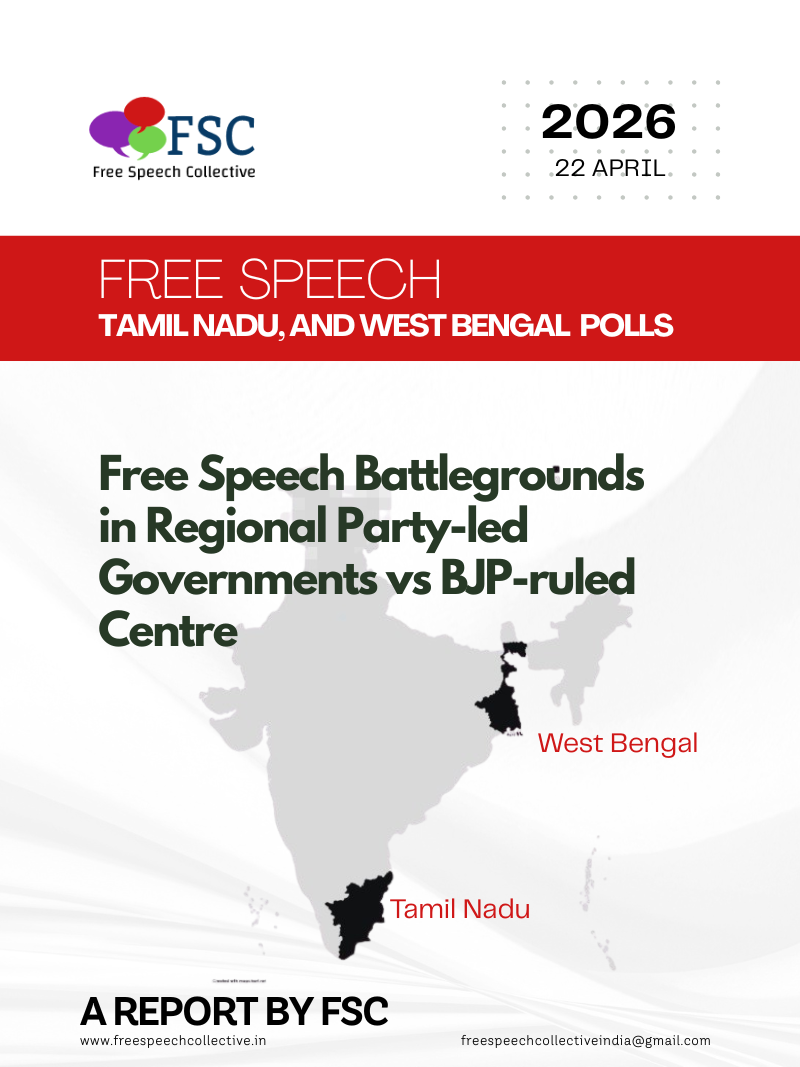
On April 23, 2026, the states of Tamil Nadu and West Bengal will go to the polls. This special report by Free Speech Collective includes special commentaries from independent journalists Urvashi Sarkar on West Bengal and Kavin Malar on Tamil Nadu.
West Bengal Elections, Mamata and the Media
A Free Speech Collective Overview
The wooing of the media and attacks on journalists go hand in hand in West Bengal, the latest being the shocking promise from the BJP of Rs 5000 to journalists, an offer that smacks of inducement to the media barely a week before the polls.
West Bengal goes to the polls between April 23-29, 2026, to elect 294 members to the Legislative Assembly. The Trinamool Congress (All India Trinamool Congress or AITC) has been in power since 2011, ending the 34-year rule of the Left Front. In addition to anti-incumbency, the party has had to contend with the Special Intensive Revision (SIR) of the electoral rolls, which removed around 9 million voters and left the status of around 2.5 million voters undecided, a majority of them Muslims and Dalits, rendering them unable to vote.
The BJP’s announcement of a Rs 5000 monthly allowance to accredited journalists of West Bengal was made by the state BJP president Samik Bhattacharya at a meet-the-press in the Kolkata Press Club on April 18, 2026. He said that there would be no “division” amongst the journalists and all those who met the eligibility criteria would avail the “benefit,” if the BJP came to power in the state. News reports didn’t specify on what grounds this amount would be disbursed to journalists.
The announcement came as a response to journalists’ queries on the BJP manifesto for a monthly financial assistance of Rs 3,000 to women and unemployed youth in West Bengal and the announcement of Union Home Minister Amit Shah that the money would come from curbing corruption under the Trinamool Congress government. The BJP has been open about their cultivation of supportive media and have tried their best to make a dent in the support base and the image of West Bengal Chief Minister Mamata Banerjee.
Mamata Banerjee’s relationship with the media has been alternately supportive and combative. She has never shied away from holding press conferences, even if she registered her vociferous rejection of negative media coverage, especially over issues of corruption and criticism over the government’s mishandling of cases of attacks on women.
Mamata Banerjee has been savvy about national issues related to privacy and state surveillance. In 2021, her government announced a Commission of Inquiry over the Pegasus spyware issue, stating that the Central government had failed to do anything over it. The former Supreme Court Justice Madan B. Lokur and former Calcutta High Court Chief Justice Jyotirmoy Bhattacharya were appointed to investigate allegations of illegal surveillance.
However, in December 2021, hearing multiple petitions challenging the use of spyware for surveillance, the Supreme Court stayed all proceedings of the Commission of Inquiry. The case is still pending and the Supreme Court, which observed that there was nothing wrong if a government uses spyware on citizens, but would determine the limits to be placed when the government conducts surveillance.
Mamata Banerjee also spoke out against attacks on the media and came out strongly against the NDA government’s raids on Hindi newspaper Dainik Bhaskar, following its reporting on the Covid 19 pandemic in 2021. She tweeted : “The attack on journalists & media houses is yet another BRUTAL attempt to stifle democracy.” In January 2026, she accused central agencies of defaming people and called for a ban on media trials before final court judgments.
Her stand on press freedom has not been linear, however. Back in a 2021 interaction with the media, she promised rural journalists that they could get government advertising if they showed the government in a “positive” light. The government’s control over disbursal of advertising continued. In 2023, despite a Calcutta High Court order that “so-called political affiliation is not an impediment” to the allocation of advertisements to CPM-affiliated newspaper Ganashakti.
The Trinamool Congress party leaders have been vocal about censorship. Party MP Derek O’Brien has raised censorship in Parliament multiple times, accusing the Lok Sabha speaker of disallowing opposition MPs from speaking. However, the AITC also came in for its share of criticism for internal party censorship when, in August 2022, it censured its spokesperson Kunal Ghosh and prevented him from public comments on suspended party leader Partha Chatterjee.
Nevertheless, in February 2024, the AITC nominated television journalist Sagarika Ghose to the Rajya Sabha and in March 2026, the party nominated senior lawyer and queer rights advocate Menaka Guruswamy to the Rajya Sabha.
Attacks on journalists
There have been several attacks on journalists in West Bengal as journalists were targeted by mobs protesting the Wakf Board amendment, the Sandeshkhali incident, the RG Kar case. A few significant instances of free speech violations:
February 19, 2024: Journalist Santu Pan of Republic Bangla was arrested by police live on air in Sandeshkhali village in North 24 Parganas district when he was covering protests sparked by allegations of sexual harassment and sexual assault of women by top TMC leaders in the area. Pan’s arrest, which was captured on video was on the basis of a complaint by a woman alleging that he had trespassed into her house. He was granted bail by Calcutta High Court on February 22, 2024, and the court ordered a stay on proceedings against him.
Republic TV said that its reporter Bhasker was also assaulted a few days earlier.
April 12, 2025: Maidul Islam, journalist with the Bengali daily Dindorpon, was attacked and his motorcycle burnt when he was covering protests against the Waqf Amendment Act. Islam told CPJ that his motorcycle was clearly marked “Press” and police did nothing when he was attacked.
January 16, 2026: Journalist Soma Maity and cameraperson Ranjit Mahato reporting for Zee 24 Ghanta, were assaulted in Beldanga in Murshidabad district, West Bengal, when they were covering protests sparked by the death of a migrant worker in Jharkhand. Maity was manhandled and told CPJ that she was grabbed and lifted by two men, who pulled her hair, restrained her legs, and tore at her clothes as others touched her body. Her cameraman sustained head injuries during the assault and required hospitalization.
January 17, 2026: Parthapratim Ghosh, a reporter with news channel ABP Ananda, and photojournalist Ujjwal Ghosh were assaulted in the ongoing protests in Beldanga. The protesters tried to grab their cameras and prevent them from recording the protests. Police detained some persons allegedly involved in the assaults.
February 25, 2026: A mob assaulted Mayukh Thakur Chakraborty, a correspondent with news channel ABP Ananda, when he was covering the brutal killing of a real-estate promoter, Safiq Khan, who was shot dead in Howrah. The journalist was assaulted when he questioned Trinamool MLA, Goutam Chowdhury, over his links to the alleged assailant, Harun Khan. Chakraborty told PTI that the attack on him and his crew was orchestrated barely 10 minutes after he interviewed Chowdhury. “A mob of about 15-20 men dragged me from GT Road inside one of the lanes and showered me with the choicest invectives while raining blows and kicks. They alleged I was bringing a bad name to the place. Most of the people assaulting me didn’t even know why they were beating me up,” Chakraborty said.
West Bengal elections: A Communalised and Polarised Environment
By Urvashi Sarkar
The Three-time Chief Minister of West Bengal Mamata Banerjee is facing a tough electoral battle against the BJP in the upcoming state polls. The BJP which has historically had little sway in West Bengal, which had 34 years of Left rule until Banerjee defeated them in 2011. However, over the last few years the BJP has made rapid inroads in West Bengal.
The elections are being held in a backdrop of the Special Intensive Revision which has scraped off the names of an estimated 90 lakh voters from the electoral rolls. The ruling TMC has alleged that a significant number of deleted voters are Muslim and from the Matua community. Matuas are Scheduled Caste Hindu refugees from East Bengal.
It is thus in a communalized and polarized environment that the present elections are being fought, with increasing allegations of an Election Commission which appears compromised in favour of the BJP. While SIR is the looming factor, a host of other local factors are at play.
The lack of livelihoods is a dominant issue in people’s minds. Widespread unemployment was evident when thousands of youth thronged to register for an unemployment allowance of Rs 1500 under the Banglar Yuva Sathi scheme.
Political corruption is evident with 23 percent of 1475 candidates contesting the first phase of the Bengal elections having declared criminal cases in their electoral affidavits, according to a report by Election Watch and Association of Democratic Reforms. The BJP has fielded the highest number of candidates with criminal cases, followed by the TMC, CPM, and Congress
West Bengal’s reputation as being safe for women has steeply declined. The 2024 rape and murder of a young doctor in Kolkata’s RG Kar Medical College with the involvement of TMC linked individuals had jolted the state.The following year, a 24-year-old lawyer was raped at a Kolkata law college. On the other hand, the CM’s schemes targeting the female population, such as Lakshmir Bhandar and Kanyashree Prakalpa are very popular and form the bedrock of her support among female voters.
In a political culture where reprisal and violence has been the norm and even caused fatalities, there is fear and apprehensions that things could easily turn violent. The Election Commission has restricted tourist movement in some areas and prevented the movement of motorcyles and imposed extended restrictions on the sale of alcohol. The Election Commission has deployed 2,407 companies of Central Armed Police Forces, over 2.4 lakh personnel in the run up to the election day. Many are questioning the presence of such extensive security forces on the ground
Tamil Nadu
A Free Speech Collective Overview
Tamil Nadu has witnessed a gamut of free speech violations, from attacks on journalists, lawyers, and civil liberties activists to academic censorship, blocking of websites, defamation cases, and the denial of permission for citizens to hold peaceful protests. Ironically, there was even a complaint of censorship by the Tamil Nadu Governor.
The last, which came in the wake of Legislative Assembly speaker M Appavu’s restraint to the media over coverage of the Governor’s address, was hardly unexpected, given the continued tensions between the state ruled Dravida Munnetra Kazhagam (DMK)-led alliance and the Bharatiya Janata Party (BJP)-led alliance in the Centre and the appointment of Governors close to the latter in states ruled by the opposition.
The “unofficial” block on the website Vikatan and the ongoing censorship battle over the release of the film Jana Nayagan by actor-turned politician Vijay were other fallouts of this tension and Tamil Nadu Chief Minister M K Stalin accused the BJP of using the Central Board of Film Certification (CBFC) as a BJP-led weapon.
Tamil Nadu goes to the polls on April 23 to elect 234 members to its legislative assembly. In the outgoing assembly, the DMK led a Secular Progressive Alliance (SPA) and formed the government with 159 seats while the All India Anna Dravida Munnetra Kazhagam (AIADMK) was the main opposition party with 66 seats. This time round, the AIADMK is in an alliance with the BJP, while actor Vijay’s Tamilaga Vettri Kazhagam (TVK), the Naam Tamilar Katchi (NTK) are other parties in the fray.
According to reports by the Association of Democratic Reforms (ADR) major political parties have given tickets to candidates with criminal cases against them and those with wealthy backgrounds. At least 18 per cent of candidates in the fray – 722 of the total 3992 candidates, have declared criminal cases against themselves, 466 of them being serious cases. The AIADMK leads with 118 of its 170 candidates having a criminal case against them, while 92 of the 231 candidates of the Tamilaga Vettri Kazhagam is second and 70 of the ruling DMK’s 175 candidates comes third. The ADR points out that “directions of the Supreme Court have had no effect on the political parties in selection of candidates in the Tamil Nadu Assembly Elections 2026 as they have again followed their old practice of giving tickets to candidates with criminal cases.”
Some significant instances of free speech violations in recent years:
March 24, 2026: Two journalists, including the anchor of a political discussion show on News Tamil channel, sustained injuries after being attacked allegedly by DMK men on Monday night in Karaikudi in the district.
The attack started when NTK functionary Idumbavanam Karthik, one of the participants of the show ‘Therthal Payam,’ levelled a series of charges against the DMK men in the locality, especially against functionary Sengai Maran. When the mediator, Rajesh, attempted to pacify the alleged DMK men, they created chaos and hurled chairs on him, injuring Rajesh on his head. The channel’s reporter Saddam Hussein also sustained injuries.
March 9, 2026: Censorship continued to dog actor-turned-politician Vijay’s film Jana Nayagan, which was to be screened by a Review Committee of the CBFC. The film had received a certificate with a few cuts in December 2025 but after a former member complained about use of army and religious symbols in the film, the certification was put on hold. The film makers then filed a petition before the Madras High Court and a single judge bench ordered its release with a U/A 16+ certificate, only to have it overturned by a division bench, which allowed an appeal by the CBFC.
January 30, 2026: Tiruchirappalli based reporter Kathiravan and cameraman Sabastian of a Tamil TV news channel were brutally attacked by a gang of 50 persons for attempting to probe an alleged illegal mining activity in Karur district. The quarry was allegedly owned by a DMK legislator.
November 2, 2025: PUCL national general secretary V Suresh was attacked at a public hearing on illegal mining in Tirunelveli. The anti-corruption NGO, Arappor Iyakkam, had organised the public hearing and Suresh, a senior counsel, has participated as Amicus Curiae of the Madras High Court, along with a panel of experts, including an environmentalist, a biodiversity expert, and social activists. The event was to discuss the impact of rampant and indiscriminate quarrying on the environment and livelihood of villagers in the southern districts.
When farmers from Radhapuram and Alangulam region recounted the hazards of mining like dust pollution affecting agriculture as well as cracks developing on their houses, a group of 25 men claiming to be advocates of stone quarries, disrupted the meeting. Disregarding the plea to wait, they started hurling the chairs, creating panic and commotion. They also threatened Arappor Iyakkam coordinator Jayaram Venkatesan to apologise for using the term ‘theft’ of natural resources.
May 10, 2025: SRM Institute of Science and Technology, a private university in Chennai suspended S Lora, an assistant professor associated with the Directorate of Career Centre for criticising Operation Sindoor in her WhatsApp status, on grounds that she was involved in “unethical activities.” The lecturer had posted status messages on her WhatsApp on civilian casualties and said, “Killing innocent lives for your own bloodlust and for your election stunts is not bravery and it’s not justice. It is a cowardice act!” The screenshots of the post, allegedly taken by a right winger student, were shared by a user on X (formerly Twitter).
March 16, 2025: Television channel Star Vijay self-censored a Neeya Naana episode on the 3-language policy after alleged BJP pressure. The debate was held in the backdrop of the standoff between the Union Government and Tamil Nadu over the three-language policy. The network had recorded an episode for its flagship debate show Neeya Naana, hosted by television personality Gopinath on March 3 and its promo was released on March 4. However, the channel put the episode under “review.” Sources from Star Vijay said that, after the recording, the Neeya Naana producers received specific instructions from the Star TV Group’s head office in Mumbai to put the debate on hold, citing the ‘sensitive nature’ of the topic.
January 5, 2025: Chennai Police denied permission to Arappor Iyakkam, an anti-graft organisation, to hold a demonstration against alleged corruption in coal import by the Adani Group. Following this, the group Arappor Iyakkam held a protest at their office. protested in Thirumurthy Nagar. Over 120 participants criticized the Tamil Nadu government and Adani Group for alleged corruption in coal imports and irregularities in coal transactions involving TANGEDCO and an Adani Group firm.
February 15, 2025: The website of well-known media house, Vikatan, was blocked after its publication of a cartoon lampooning Prime Minister Narendra Modi in its digital magazine, Vikatan Plus. The cartoon, which appeared on the cover of Vikatan Plus on February 10, 2025, Vikatan Plus published a cover cartoon highlighting Prime Minister Narendra Modi’s silence on the handcuffing of Indian immigrants deported from the U.S. The image depicted PM Modi with his hands chained, sitting beside U.S. President Donald Trump, criticising his inaction on the issue. This triggered backlash from BJP supporters, and Tamil Nadu BJP president K. Annamalai lodged a complaint against Vikatan with the Press Council of India and the Ministry of Parliamentary Affairs. While there was no official statement forthcoming on the block, the BJP’s Tamil Nadu unit alleged that Vikatan was a “mouthpiece” of the DMK.
December 2, 2024: Isha Foundation, led by Jaggi Vasudev, filed a defamation suit against Tamil media outlet Nakkheeran accusing them of publishing allegedly defamatory videos. In the plea submitted before the Delhi High Court on Monday, December 2, Jaggi Vasudev sought the removal of the videos and demanded Rs 3 crore as damages. He also added Google as a respondent to the case because the videos and reports are available on Google and YouTube. Nakkheeran had released a series of videos featuring its editor, Nakkheeran Gopal, discussing allegations surrounding the mistreatment of children at Isha.
January 25, 2024: Television journalist Nesa Prabhu was brutally attacked by a group of unidentified men. He reportedly made repeated desperate calls to the police control room, telling them about being tailed by a group of men on bikes without number plates and seeking their help. However, he was asked to report to the nearest police station and file a complaint.
Nesa Prabhu, who worked in Tiruppur district, has been reporting on violations and malpractices in the sale of liquor.
Audio recordings of calls made to the police were made public by his colleagues and the journalist can be heard telling police that the gang had been making enquiries about him and even visited his home when his mother was alone.
January 15, 2024: The Madras High Court ordered YouTuber Joe Micheal Praveen to Pay Rs 50 lakh as compensation to AIADMK spokesperson and trans activist Apasara Reddy, for posting defamatory material and videos against her on social media and YouTube. Apsara Reddy informed the Madras High Court that YouTuber Joe Micheal Praveen had made repeated defamatory posts against her.
For more details, do check the Free Speech Tracker.
Tamil Nadu Election: Alliances, Narratives, and Voter Sentiment
By Kavin Malar
The election scheduled for April 23 is a very important one for Tamil Nadu, a state with a unique political history. For many years, the Dravida Munnetra Kazhagam (DMK) and the All India Anna Dravida Munnetra Kazhagam (AIADMK) have come to power alternately. Only once did the AIADMK rule continuously for ten years.
Today, whether or not the DMK government led by Stalin should continue is not the main question of this election. It is a battle for federalism, and opposition to centrally imposed policies, whether Hindi imposition, or inclusion of Sanskrit in the syllabus. This struggle for state autonomy is clearly reflected in this election.
Taming through central agencies
In the ten years of AIADMK rule, the BJP tactically brought the AIADMK under its control using the Enforcement Directorate and the CBI. After a few years of separation, they again formed an alliance for the election—BJP and AIADMK. In this alliance, T.T.V. Dhinakaran’s Amma Makkal Munnetra Kazhagam (AMMK), and Anbumani Ramadoss’s faction of the Pattali Makkal Katchi (PMK) are also included.
The BJP made great efforts to bring actor Vijay’s Tamilaga Vettri Kazhagam (TVK) into this alliance. It dragged on, withholding a certificate to the film Jananayagan in which he acted. Likewise, the film Parasakthi, which tells the anti-Hindi history of the DMK, was also made to languish without certification before finally being given one. Jananayagan has not received a certificate even today.
In the beginning, Vijay declared the BJP as his ideological enemy; after Jananayagan certificate issue, he did not speak about the BJP. After 41 people died during Vijay’s campaign in Karur, he went to Delhi twice for a CBI inquiry. From the first conference at Vikravandi until now, 51 lives have been lost in Vijay’s campaigns. Many BJP members were included in TVK’s candidate list. Among them, even those accused of sexual crimes in the BJP being included in TVK’s candidate list came as a shock.
Vijay did not criticize the BJP, which was responsible for denying certification to his film Jananayagan. Instead, through second-level leaders, he implied that DMK was responsible. Next, when the film was leaked online, TVK again blamed the DMK. Vijay’s wife Sangeetha filed for divorce in court. For this too, he blamed the DMK.
Cinema, welfare, and the intellectual climate
This election campaign showed that some youth and educated people in Tamil Nadu are immersed in cinema fascination. The crowd that gathers for Vijay is proof of that. In contrast, those who have benefited from the welfare schemes of the ruling DMK want the DMK to return to power.
From the time the DMK came to power, it has given great importance to education. Model schools sending government school students to top institutions, the “Naan Mudhalvan” scheme, the “Pudhumai Penn” scheme giving ₹1000 per month to girls for higher education, the “Thavapputhalvan” scheme, laptop schemes, and the Chief Minister’s breakfast scheme in schools are notable schemes.
The monthly ₹1000 Magalir Urimai Thogai (women’s rights allowance) and free bus travel for women are very important schemes for women.
In addition to improving infrastructure such as roads and flyovers, attention was paid over the past five years to the intellectual climate. The Kalaignar Centenary Library was built in Madurai, a new policy for the procurement of books for libraries, literary festivals and book fairs were conducted by the government to encourage the reading habit.
Caste, religion, and the ballot
All Islamist parties are part of the DMK alliance. At a time when there was an expectation that Christian votes might go to Vijay in this election, statements came from churches supporting the DMK alliance. However, since Vijay is a Christian, a section among Christians may support him.
The people of Tamil Nadu usually take a stand against the BJP. Since this time the BJP and AIADMK have joined hands, there is a possibility that the votes usually received by AIADMK may decrease, as a section of votes of Vanniyars in North Tamil Nadu may go to this alliance.
Overall, since the BJP, which is a religious-ideological party, the AIADMK that supports it, the caste-based PMK, and the AMMK which relies on the Mukkulathor community are all in this caste and religion-based alliance.
Union Minister Nirmala Sitharaman’s husband Parakala Prabhakar, along with some intellectuals and activists of Tamil Nadu, carried out a campaign called “Zero BJP,” reflected in strong opposition to Prime Minister Narendra Modi during his election campaign in the state.
The Naam Tamilar Katchi party’s Tamil nationalist identity has been diluted with the BJP streak and say that the votes received by Naam Tamilar Katchi in previous elections will be split this time by Vijay’s TVK.
A disturbing feature in this election is the use of children in campaigning by both the DMK and AIADMK Alliance. During the final day of campaigning, Vijay’s speech became controversial. He made a request to children who are his fans: “Go and ask your mother, father, aunts, uncles, and all elders at home to vote for this Vijay uncle. Just as you insist stubbornly to get a chocolate or a Kinder Joy, insist like that and ask them to vote for me.”
According to Election Commission rules, involving children in election campaign activities is a punishable offence, said child rights activist Devaneyan.
Media bias in image building
The votes against the ruling party are being split among three fronts. The AIADMK-BJP alliance, TVK, and Naam Tamilar are dividing the anti-incumbency votes among themselves. Therefore, many believe that the DMK will win.
Just as Modi’s image was exaggerated before the 2014 parliamentary elections, Vijay’s image has been exaggerated by Tamil Nadu media. For the first time, media telecast live even his few hours of road travel starting from his house. This led to heavy criticism of the media.
If some Tamil Nadu media created this narrative, the so-called national media and English channels also acted with bias. This is not new to Tamil Nadu. When Jayalalithaa was alive, English media also addressed her as “Amma” as if the whole Tamil Nadu called her ‘Amma,’ while only AIADMK members addressed her as such. At the same time, M. Karunanidhi, whom many people beyond DMK call “Kalaignar,” is often called simply “Karuna” by English channels. DMK supporters say this is due to the perspective of English media towards non-Brahmin leaders.
The term “Magalir Urimai Thogai (women’s rights allowance)” has strong self-respect in it. It is not a freebie. It is named to mean a rightful payment for women who work without wages at home. But English media do not translate it directly and instead call it “cash transfer.” The same media call the women’s reservation bill “Nari Shakti” in Hindi. Why not translate Magalir Urimai Thogai properly as “women’s rights allowance”? Why use “cash transfer”? When an English Channel says “DMK believes its cash transfers will bring votes from women,” what will a North Indian who does not know about this scheme think?
In news about South India, especially Tamil Nadu, English media are often one-sided and mostly favourable to the BJP. This election is not an exception.
Delhi vs Tamil Nadu
Earlier, the Union Government said that if the three-language policy is not implemented, Rs 2,291 crore under Samagra Shiksha cannot be released to Tamil Nadu’s school education department. The Tamil Nadu government said it cannot implement the three-language policy and will continue the two-language policy. The funds have been withheld till today.
The then Governor R.N. Ravi interfered in Tamil Nadu matters beyond his authority. The DMK government opposed this legally up to the Supreme Court and won.
Due to GST brought by the Union Government, industries like the Tiruppur knitwear industry suffered. Post the war between Israel and the US against Iran, people are suffering due to gas cylinder issues, affecting both families and industries, and this crisis is seen to be mismanaged by the Centre.
Threats to communal harmony
Near Thanjavur, in Michaelpatti village, a girl student died by suicide. BJP leader Annamalai campaigned that it was due to forced religious conversion in a Christian school. The Tamil Nadu government denied it. The case went to the CBI. The final judgment said no conversion took place, supporting the DMK government.
The BJP attempted to turn Thiruparankundram in Madurai into another Ayodhya. Hindu groups demanded lighting a temple lamp near the dargah situated at the top of the Thiruparankundram hill. In spite of High court’s judgement in favour of lighting lamp near dargah, the Tamil Nadu government steadfastly refused and maintained the traditional practice. By not implementing the court order, it preserved communal harmony and protected the rights of Muslims and also allowed people of all castes to become temple priests.
Conclusion
Just before the election, the Union Government’s constituency delimitation bill was successfully opposed. It was manipulatively linked with the women’s reservation bill. MK Stalin reacted immediately, even burning a copy of the bill and warning the Union Government.
Even during campaigning, Tamil Nadu MPs went to Parliament and voted. As expected, BJP and AIADMK later claimed DMK opposed women’s reservation, but it did not gain traction among people. Chief Minister MK Stalin has described this election battle as “Delhi vs Tamil Nadu.” That is indeed the reality.
(Kavin Malar is an independent journalist based in Chennai.)
Download a PDF version of the full report here.