
The Throttling of Free Discussion in Academia: Strong-arm Tactics by ABVP and Cave in by Azim Premji University
– A Free Speech Collective Commentary
The vandalism and violence by members of the Akhil Bharatiya Vidyarthi Parishad (ABVP) against a proposed discussion on February 24, 2026, by “Spark”, an informal student reading group of Azim Premji University (APU), Bangalore, are symptomatic of the increasing repression in campuses across the country, where dissent is criminalised and free debate and discussion is shut down. The proposed discussion was on the anniversary of the mass rapes in Kunan Poshpora in 1991.
On February 24, around 25 members of the ABVP, the student wing of the Bharatiya Janata Party (BJP) vandalised the “Kabira” space, a designated location for cultural activities in the Sarjapur campus of the university and the venue of a discussion on Kunan Poshpora by the Spark Reading Group. They tore down posters and assaulted a student and a member of the university’s security staff.
While police arrested 25 members of the ABVP on charges of assault, vandalism and trespass., they were granted bail the next day.
However, police also registered an FIR, based on a complaint by the APU Registrar Rishikesh BS, against office-bearers and members of the Spark Reading Circle. The complaint against the group’s Instagram handle on the event was registered under Sec 299 of the Bharatiya Nyaya Sanhita (BNS) 2023, on charges of deliberate and malicious acts intended to outrage religious feelings, a cognisable and non-bailable charge with a penalty of up to three years imprisonment.
The FIR also cites charges under Sec 66 (e) (violation of privacy by intentionally capturing, publishing, or transmitting images of a person’s private areas without their consent) and 67 (publishing or transmitting obscene material in electronic form) of the Information Technology Act,2000.
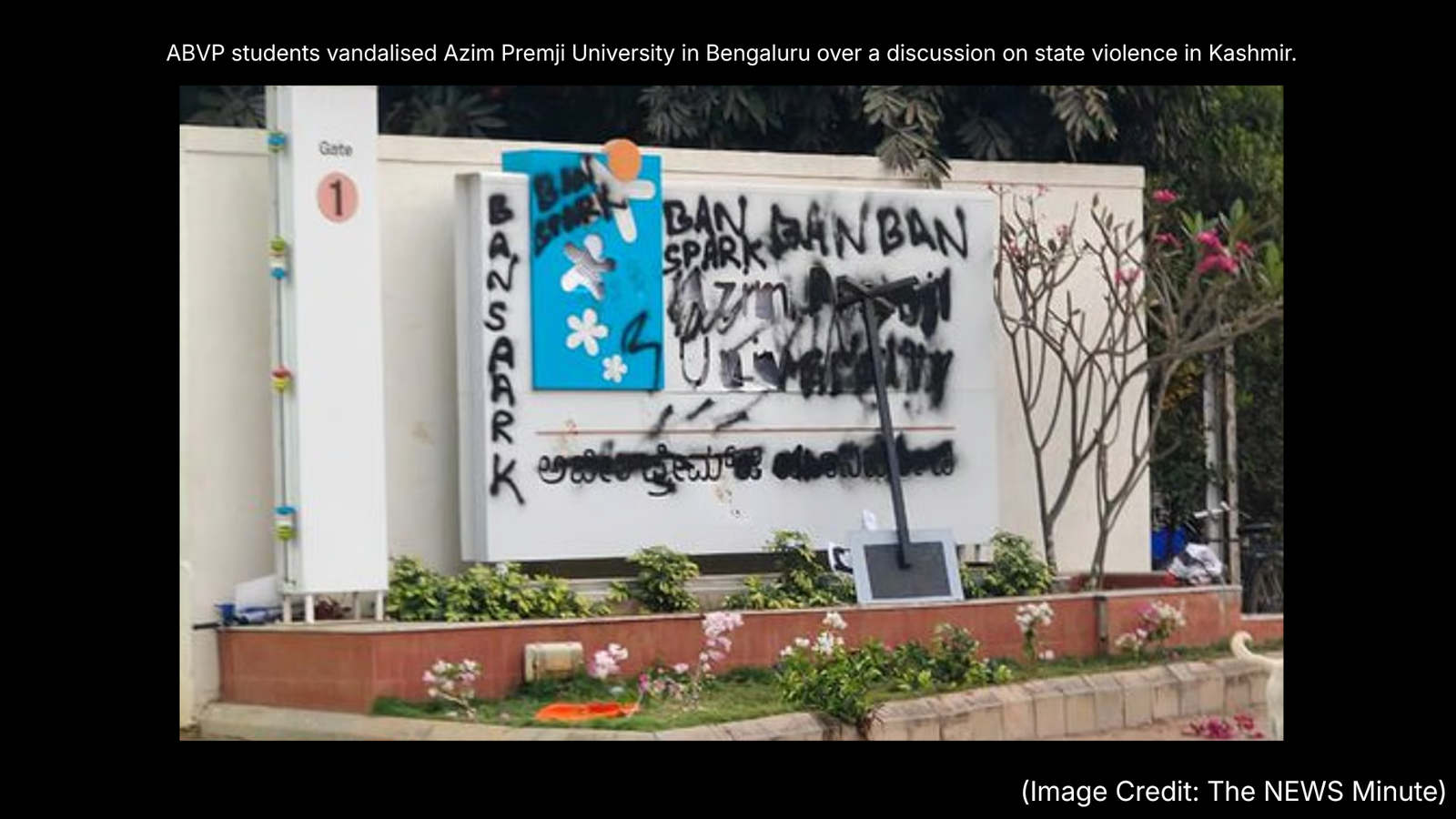
The APU Registrar’s complaint states that no permission was sought or granted for the event and that the group had no official connection with the university. The complaint further blames the reading group for seeking to host the event and said that, by “issuing such invitations, hostility arose between two groups, resulting in activists forcefully entering our campus and creating a disturbance.”
In a statement, the Student Council of Azim Premji University expressed concern over the FIR filed by the university against members of the ‘Spark Reading Circle’, stating that the matter should have been addressed through internal disciplinary mechanisms rather than criminal proceedings.
Indeed, the excessively punitive reaction of the APU administration towards the student reading group for merely planning to hold a discussion on the Kunan Poshpora incident is highly disturbing. A purely administrative and logistical issue of permissions for an event on campus became the basis of a complaint to the police to seek criminal action against a reading group and its members. The complaint against the group’s account on a social media platform amounts to an open invitation to police the academic lives of students. In the guise of a criminal investigation, it allows for surveillance of electronic devices of students and seeks to police their space and time outside the classroom.
Why don’t they want people to remember Kunan Poshpora?
The ABVP’s protest against the Spark Reading Group’s discussion over Kunan-Poshpora seeks to erase and invisibilise the crucial process of recollection and analysis of painful and sensitive incidents, thereby silencing a historical record.
February 24, 2026, marked the 35th anniversary of the mass rape and torture of women of the villages of Kunan and Poshpora in Jammu and Kashmir by the Indian Army. The allegations of rape and torture were denied by the army and the Indian government.
However, the testimonies of women of the two villages and the extensive records and interviews by researchers Essar Batool, Ifrah Butt, Munaza Rashid, Natasha Rather and Samreena Mushtaq, who documented the incident and its aftermath in their book “Do You Remember Kunan Poshpora?” continue to challenge official narratives even as they persist in the struggle to seek justice and accountability. The book was among the 25 academic books banned in Kashmir last year.
Systematic censorship of academia
The violence by the right wing ABVP, the student wing of the Bharatiya Janata Party (BJP) and the ominously repressive measures taken by the APU administration result in the censorship and curbs on free discussion and debate on important issues. They are only the latest in the growing list of instances of censorship in academia.
Right-wing students are emboldened and weaponised by the ruling political dispensation. Regrettably, university administrations, including vice chancellors who are unabashed champions of right-wing ideologies, speedily crack down on students who dare to ask questions.
Last year, Free Speech Collective’s annual report “Free Speech in India 2025: Behold the Hidden Hand” documented at least 16 noteworthy instances of censorship in academia, including the criminalisation of student protests, the Delhi University Vice-Chancellor Yogesh Singh’s openly political exhortations to faculty and staff to push the ruling BJP’s agendas and the arrest of Prof Ali Khan Mahmudabad of Ashoka University over posts on Operation Sindoor even as the denial of permission for academic seminars on “sensitive subjects” became routine.
Now, barely two months into 2026, there are already more than six instances of censorship in academia in India.
At least 14 students of Jawaharlal Nehru University (JNU) were arrested for protesting the casteist remarks of the university’s Vice Chancellor Shantisree Dhulipudi Pandit. Granted bail by a Delhi court on February 27, the students continued to remain in jail till late evening on Sunday (March 1) as police took their time to complete the verifications of their permanent addresses. It took the court to direct their immediate release stating that procedural formalities could not be the excuse for their continued detention after bail had already been granted.
Earlier, on February 17, 2026, the Proctor Office of Delhi University (DU) issued an order stating that “public meetings, processions, demonstrations, and protests of any kind are strictly prohibited within the university campus for a period of one month.”
On January 29, 2026, Sarover Zaidi, an associate professor at OP Jindal Global University in Sonepat, was suspended for one semester (February 1 to July 31) for allegedly comparing Prime Minister Narendra Modi with Adolf Hitler. BJP MP from Kurukshetra Naveen Jindal is the founding chancellor of the university.
The action arose after a hearing in the Haryana Human Rights Commission (HHRC) on a complaint by Vishav Bajaj, father of Vikhyaat Bajaj, a first-year undergraduate student of the Jindal School of Design & Architecture, that on November 7, 2025, during a lecture on the course “Politics of Representation” taught by Zaidi, repeated remarks were made in class that were “politically derogatory, inflammatory and deeply disturbing”.
Bajaj alleged that PM Modi was compared to Adolf Hitler, national security operations such as Operation Sindoor were described as “gimmicks” and “branding exercises,” civilian deaths were trivialised and official accounts of terrorism were questioned. Audio recordings made by Vikhyaat were also submitted to the HHRC.
The student had also complained against another assistant professor, Ekta Chauhan, alleging their statements against the RSS. But Chauhan refuted the allegations and described herself as a “devout and practising” Hindu. Her family was associated with RSS-linked social service traditions since 1972, she said in a written statement.
The trend of disinvitation of distinguished persons from campus events continued unabated. In Banaras Hindu University, a lecture by scholar Kedar Mishra, scheduled for January 20, 2026, was cancelled allegedly under government pressure In Mumbai, actor Naseeruddin Shah was disinvited from an academic literary event at Mumbai University on January 31, 2026.
In Mumbai, an SRFTI (Satyajit Ray Film & Television Institute) student film “Da’Lit Kids” was pulled out of the Animela Film Festival at Whistling Woods after it was reportedly denied permission for screening by the Ministry for Information and Broadcasting. In protest, film-makers of all the SRFTI films scheduled for screening at the festival pulled out but the festival went ahead.
The Animela Festival is an international Animation, VFX, Gaming, Comics & XR Festival run by a non-profit organisation – the Aniverse and Visual Arts Foundation (AVAF). While there is no clarity why government permission was sought for the films being screened, the festival website lists multiple sponsors, including the Maharashtra government, embassies of France and Australia and corporate support from sponsors like Adani.
All these instances of censorship further circumscribe the space for the free exchange of information and diverse viewpoints. APU prides itself on being “a space for social change” and a space for higher education that “can create critical and reflective practitioners with an understanding of the social impact of education, the law and development”. Instead of criminalising students, APU needs to ensure that its campuses remain safe spaces that nurture the spirit of enquiry. For a truly transformative educational institution, a climate of free discussion needs to prevail over censorship by vandals and vigilantes.
Statements:
Click here to endorse statement by APU alumni: https://docs.google.com/forms/d/e/1FAIpQLSdfMNrYWIN-VEai3XtrOM0XjLyEFvAwnrzWf3JNGPG3sBl62g/viewform
Click here to endorse statement by academics and civil society members: https://docs.google.com/forms/d/e/1FAIpQLSftsz2tSNhGbljTo-wiBz5MS9pgKwB2vHAd6x-t94LHst7iwg/viewform
Related

Commentaries