
Irfan Mehraj : How A Journalist is Put Out of Circulation
What does World Press Freedom Day mean to Jailed Journalists in India?
This World Press Freedom Day 2026, Free Speech Collective poses this question for two journalists who are behind bars in India – Jharkhand-based Rupesh Kumar Singh and Jammu and Kashmir journalist Irfan Mehraj. Irfan Mehraj, editor of Wande magazine was arrested on March 20, 2023, on charges under UAPA. The trial is yet to begin.
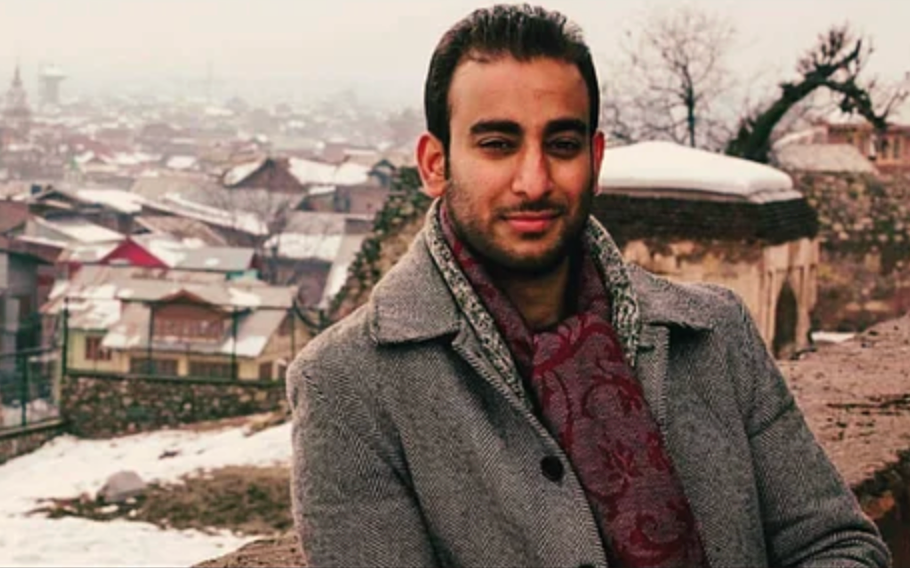
Read the account on Irfan Mehraj, editor of the evocative Wande magazine that sought to explore Kashmir’s complex politics, its rich history and culture, before it went quiet after his arrest. Mehraj’s detailed documentation of torture and fearless stance on state violence marked him out and now, his work lies buried, struggling to be remembered.
(Read the Account on Rupesh Kumar here)
By a correspondent*
On March 20, 2023, journalist Irfan Mehraj, based in Srinagar, got a call from the office of the National Investigation Agency (NIA) asking him to drop by the office.
He was told it was for five minutes of questioning but it turned into an arrest, said his father to the media. Mehraj was taken to Delhi the next day and remanded to NIA custody on March 22. His brother and uncle were then forced to rush there to get more information and arrange legal services. Other family members, including his wife to whom he had been married for just about six months, were left waiting anxiously at home.
Lodged since in the Rohini prison complex in New Delhi, under the Unlawful Activities (Prevention) Act (UAPA), he has been a pre-trial prisoner for over three years. The distance between his home and Delhi and the fact that his father has a deteriorating health condition make it difficult for them to make the mulaqats or scheduled meetings between jail inmates and their families, friends or legal counsel. It is generally conducted through a glass partition and an intercom. This of course precludes any physical contact.
It was not the first time Mehraj had been summoned by the NIA. Repeatedly called to Srinagar and New Delhi offices he had been questioned extensively in connection with a case lodged in 2020 against the Jammu and Kashmir Coalition of Civil Society (JKCCS) for alleged terror funding and secessionist activities. Khurram Parvez, the programme director had been arrested in November 2021 under UAPA and the NIA claimed they were probing Mehraj’s close association with him. Proceedings for hearing bail began in 2024 but there have been multiple changes of the Judge with prolonged delays.
Mehraj’s arrest caused much perturbation amongst his colleagues in the local Kashmiri media. National and international media organizations too condemned the incarceration of a journalist as yet another example of stifling the right to freedom of expression and criminalization of legitimate human rights concerns. The Journalist Federation of Kashmir, the Press Club of India, Amnesty International India, Human Rights Watch, the Committee to Protect Journalists, and other organizations issued statements calling for his release. Mary Lawlor, UN Special Rapporteur on Human Rights Defenders, tweeted that she was deeply concerned on Mehraj’s arrest and called for “immediate release.”
Summons and even arrests under anti-terror laws are regrettably not an unusual trend in Kashmir. Nityanand Rai, state minister for Home Affairs told Parliament that Jammu and Kashmir leads in the number of arrests made under the Unlawful Activities (Prevention) Act with a total of 1206 arrests being made in 2023 which accounts for 42 per cent of the total number of arrests. Despite the high number of arrests the Union Territory recorded only 10 convictions bringing the conviction rate to 0.8 %, one of the lowest in the country.
A report by BBC points out how it is very common for a journalist to be summoned by the police over reports they have written and to be detained. Others are summoned for what is said to be “routine background checks.” The police though warn journalists during these checks that the surveillance is being extended to not just what they as journalists do but also extends to the families and siblings.
It is no coincidence that Kashmir has earned the dubious distinction of being one of the most challenging and risky places to work out and report from over the decades. Besides the physical violence journalists faced in the nineties in this conflict zone, an increasingly repressive climate has been fostered by the state especially after the abrogation in 2019 and the imposition of a new media policy in 2020 which gives powers to the state to determine what is “fake” news “unethical” or “anti national”. Surveillance, intimidation, threats and arrests have grown substantially.
Early this year, following a tweet by a former resident editor of the Indian Express, it was found that correspondents of major national dailies had been summoned by the police after they had reported on the Kashmir police’s bid to profile certain mosques. DigipubNews India Foundation strongly condemning the repression in Kashmir said it had now expanded from local Kashmiri journalists to reporters from major national media and freelancers, even as several large media houses remain silent _leaving the most vulnerable journalists to bear the brunt.
Silence is not a new phenomenon. One of the most significant aspects of Kashmir is the way the average or baseline citizen witnesses or experiences violence, which is so seldomly reflected in the national media. There is a huge chasm between the lived experiences of Kashmiris and what is written about them whether it is in the official narratives or then those scripted by corporate media houses.
When it comes to Kashmir, nationalistic concerns affect even “liberal” circles especially when it comes to contentious issues with terms like “terrorist” becoming contiguous with ideas of expressing political aspirations and ideas of self-determination. Even though, as a legal activist points out, there is nothing in the Constitution that makes it illegal.
Such a fragile media ecosystem and lack of backing or protection for the Kashmiri journalists who dare to report truth, leaves them in a very vulnerable position. Only the very brave and committed would embark on such a career.
Mehraj, who may be considered one such individual, chose to pursue a master’s degree in mass communication and journalism from the University of Kashmir. He began by writing blogs and also worked as an intern in Kashmir Life. Later working as an independent journalist he wrote for reputed publications and digital platforms such as The Caravan, Himal, Article 14, Al Jazeera, Deutsche Welle, TNT and many others.
Keen on exploring Kashmir’s complex politics, its rich history and culture, Mehraj co-founded Wande (meaning winter). It was an attempt to “freeze” Kashmir into the imagination. The digital platform offered several insightful reflective pieces that went far beyond mere reporting. It has gone offline after Mehraj’s arrest.
It was also his deep interest in long form writing that led to his association with the JKCCS, the human rights organization, that had gained a name for its meticulous documentation and research. Khurram Parvez, the jailed programme director, had received the 2006 Reebok Human Rights Awards and was included in Time magazine list of the 100 most influential people in 2022.
Mehraj, in his capacity as a journalist with writing skills was among those who helped shape the seminal and comprehensive report on torture by the JKCCS. It was acclaimed by Juan E Mendez, former UN Special Rapporteur on Torture And Other Cruel, Inhuman or Degrading Treatment or Punishment), as a “model for dispassionate and precise language even when discussing tremendously tragic suffering.”
It was perhaps a combination of all these endeavours that attracted the authorities’ attention to the fact that Mehraj was not just a mere reporter but a fearless one in expressing dissent on certain state narratives and asking uncomfortable questions.
UAPA was the weapon to keep him out of circulation. An article in The Wire explains how Mehraj’s case not only reveals flaws in the prosecution’s case but also underscores broader concerns about the law. It reflects how UAPA functions as a mechanism of state control, enabling far reaching restrictions on dissent.
UAPA, the article, further analyses, enables the state to construct the identity of a terrorist as a political tool. It casts its net wide enough to include journalists, activists and human rights activists who challenge the government’s narrative.
The charges brought and arguments against granting of bail are labelled as extremely serious but the evidence of terror, when produced, is very flimsy which eventually results in an acquittal.
As becomes clear with UAPA the process becomes the punishment. Trials take very long. Mehraj, sitting in jail, has been put out of circulation, cut off from family and a close knit community. The best years of his life are lost. Arrests and intimidation are the means to control people, to erase history, obliterate dreams. So what is the recourse? A close friend of Mehraj answered, “Memory. We remember the political prisoner. The ones put away.”
(The writer, a colleague of Irfan Mehraj, chose to remain anonymous)
Related

Commentaries