
May 3, 2026: What does World Press Freedom Day mean to jailed journalists in India?
This World Press Freedom Day 2026, Free Speech Collective poses this question for two journalists who are behind bars in India: Jharkhand-based Rupesh Kumar Singh and Jammu and Kashmir journalist Irfan Mehraj.
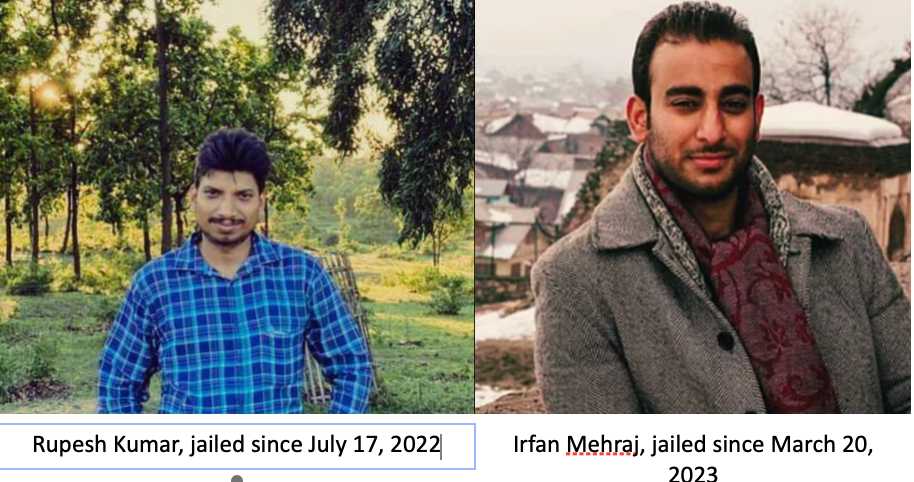
While we have an account written by Ipsa Shatakshi, writer and wife of Rupesh Kumar Singh, another account on Irfan Mehraj is written by his journalist colleague, who chose to remain anonymous.
Rupesh Kumar Singh was arrested on July 17, 2022, on charges under the draconian Unlawful Activities (Prevention) Act (UAPA), 1967, and a trial is on. Irfan Mehraj, editor of Wande magazine was arrested on March 20, 2023, on charges under UAPA. The trial is yet to begin.
(Read the account on Rupesh Kumar here)
(Read the account on Irfan Mehraj here)
Introduction
In India, impunity marks the killing of journalists, with few convictions and acquittals of powerful perpetrators. There is little accountability for the patently unjust arrest of journalists, for illegal and informal detentions or even the prolonged litigation proceedings for journalists facing criminal cases for reporting on corruption and wrongdoings of political leaders.
Over the last year, five journalists were arrested in India, on charges relating to reporting on corruption and comments and criticism of elected leaders, election coverage in West Bengal. The RSF Press Freedom Index placed India’s rank at 157 out of 180 countries, categorising it as “very serious”.
The RSF country report states:
With a rise in violence against journalists, highly concentrated media ownership, and outlets with increasingly overt political alignment, press freedom is in crisis in “the world’s largest democracy,” ruled since 2014 by Prime Minister Narendra Modi, leader of the Bharatiya Janata Party (BJP) and embodiment of the Hindu nationalist right.
The RSF report recorded zero killings for 2026, but barely a week before its report was released, journalist Jaganmohan Reddy of ABN Andhra Jyothy, was chased and killed when he was out for a morning walk near his house in V Kota town of Chittoor, the home district of Andhra Pradesh Chief Minister Chandrababu Naidu. Another journalist, Subrahmanyam, who was with him, was also stabbed and sustained serious head injuries.
Reddy, according to reports, had written articles on the smuggling of red sanders, a high value wood used in furniture, medicine and dyes. Cultivation of the endangered wood is highly regulated and and had lodged complaints about the inaction of forest and police authorities against a local smuggler, Thameem, over two years ago, but to no avail.
Reddy’s killing is only the latest in the long list of journalists murdered in India. Last year was marked by the brutal killing of Mukesh Chandrakar in Bastar, Chhattisgarh and Rajeev Pratap, found dead in the Bhagirathi river in Uttarakhand days after he had done a video report on unhygienic conditions in a district hospital. To make matters worse for journalists, a 17-year investigation and trial into the killing of journalist Ram Chandra Chhatrapati in Haryana and the conviction of Gurmeet Ram Rahim, head of the Dera Sacha Sauda religious order, resulted in the acquittal of the latter.
The use of lawfare – the law, its mechanisms and its institutions and agencies – to intimidate and harass journalists is not specific to the State. Apart from governments, the law has been weaponised and has become a handle tool for corporate and private organisations, vigilantes and vested and motivated interest groups to launch proceedings against journalists, with cases that go on for years with no respite or conclusion. The punishing process is liable to wear down resistance, and the chilling effect is complete.
Read the account by Ipsa Shatakshi on the daily struggle to even meet Rupesh Kumar who is transferred to a jail far from his family, making it difficult for them to visit. The distance is not merely a punishment for reporting truth to power but seeks to batter the fighting spirit of both the journalist and his family.
Read the account on Irfan Mehraj, editor of the evocative Wande magazine that sought to explore Kashmir’s complex politics, its rich history and culture, before it went quiet after his arrest. Mehraj’s detailed documentation of torture and fearless stance on state violence marked him out and now, his work lies buried, struggling to be remembered.
Related

Commentaries